Blog post
Salted coffee at a Turkish engagement: what the tradition really is
In a Turkish custom, a bride-to-be may put salt in place of sugar in the coffee she serves the groom when his family visits to ask for her hand. He is expected to drink it without complaint. It happens at this visit, before the engagement, and only his cup is salted. Its origin is not documented.
By Ahmet Kırtok · Updated November 26, 2026 · 5 min read
What is the salted coffee tradition?
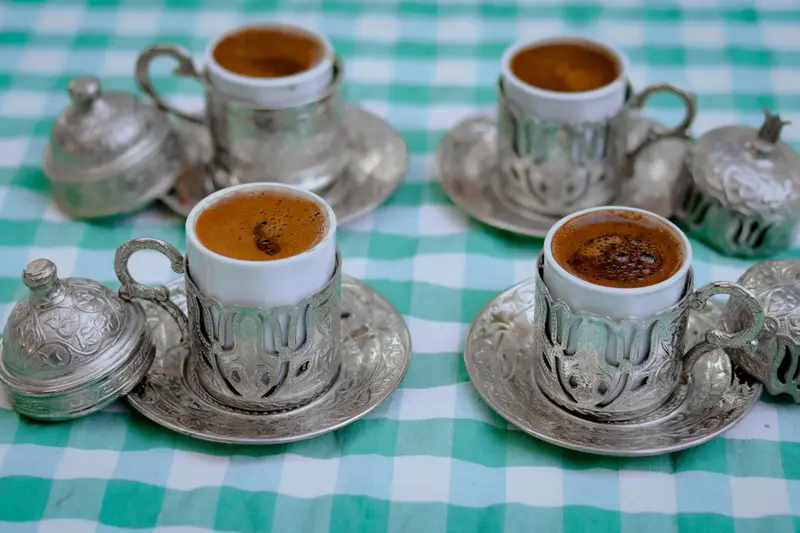
It is a small test staged inside a formal family visit. The bride-to-be prepares Turkish coffee for the guests, and into the groom's cup goes salt in place of sugar. Everyone watches him drink. If he finishes it calmly, he passes.
The custom is widely known in Turkey, and one English-language report on Turkish wedding customs calls it among the best known of them. It is also frequently misdescribed online, so the sections below separate what sources agree on from what gets added in the retelling.
When does it happen?
It happens at the kız isteme (kuhz ees-teh-MEH), the visit where the groom's family comes to the bride's family home to ask formally for her hand. That visit comes before the engagement and well before the wedding.
The usual order of events, as Turkish newspapers describe it:
- The groom, his parents and often other relatives visit the bride's family home.
- The bride-to-be makes Turkish coffee and serves it to the guests.
- The groom's cup is the salted one. He drinks it.
- An elder of the groom's family, typically his father, makes the formal request.
- If the bride's family agrees, rings may be exchanged as a promise to marry.
UNESCO's description of Turkish coffee culture notes the role coffee plays at engagement ceremonies and other social occasions. It does not mention salt. The salt is a playful custom layered on top of the serious business of serving coffee to guests.
What is the salt supposed to mean?
Sources give several meanings, and no single one is official. The most common: it tests the groom's temperament, and a man who drinks salty coffee without a grimace is taken to be patient and good-natured. Others say it shows he will put up with hardship for the woman he loves.
| Interpretation | Where it is reported |
|---|---|
| A test of temperament: he drinks without showing distaste | Middle East Eye |
| Proof he will endure trouble for the woman he loves | Daily Sabah |
| A reminder that marriage is not always sweet | Middle East Eye |
| A sign that he is good-natured and willing to endure hardship | Informants in the USC Digital Folklore Archives |
All of these can be true at once. A custom passed down by imitation gathers explanations as it goes, and families hold whichever one they were told.
What gets misreported about it?
Four things, mostly. The custom belongs to the asking visit and has nothing to do with the wedding day. Only the groom's cup is salted. It is a game with the family watching, and the proposal does not depend on it. And nobody can say with evidence where or when it began.
- Timing. Articles and videos often call it a "wedding tradition." The coffee is served at the kız isteme.
- Who drinks it. The other guests get ordinary coffee.
- What is at stake. The reports we read describe a test of composure. None describe a marriage called off over a reaction to salty coffee.
- Origin. We found no source that documents when the custom started. Stories that assign it to a particular century or court are unsupported, as far as we can tell.
A related point appears in a 2018 review in the journal Turkish Studies: well-foamed coffee at the asking visit shows respect and the skill of the bride's household. That is a separate matter from the salt. On why foam carries so much meaning, see the foam guide.
Is it only salt?
Salt is the classic ingredient, and the amount is generous. One report describes large spoonfuls. In the retelling, other additions appear. People interviewed for a university folklore archive mentioned pepper and spices, and passed along a secondhand tale about a groom who came to harm after a heavily spiced cup.
They were not sure the tale was true, and neither are we. It works as a warning inside the tradition itself: the point is to tease, and the coffee should stay drinkable.
How common is it today?
We found no survey of how many couples still do it. Middle East Eye calls it one of the most widely known customs around Turkish weddings, and the folklore archive entry records a Turkish couple in Los Angeles who knew the custom well and had not followed it themselves.
Customs like this vary by family, region and generation. Turkey is large and diverse, and a description that fits one household will not fit every one. The safest summary is that the custom is widely known, and that each family decides how seriously to play it.
How is the coffee itself made for the visit?
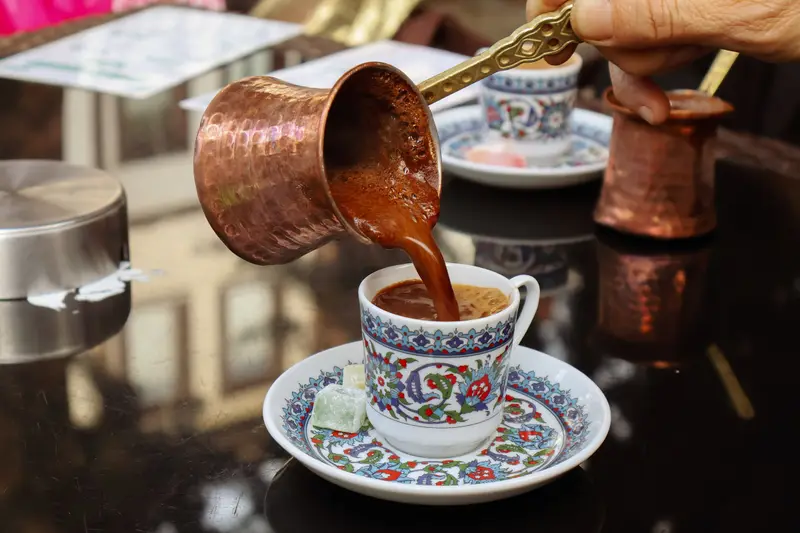
Apart from the one doctored cup, it is ordinary Turkish coffee, made with extra care because guests are watching. It is brewed in a cezve (JEZ-veh), the small pot many English speakers call an ibrik.
Serving many cups at once, each with good foam, is harder than it sounds, and a well-made tray is a quiet point of pride. Our guide on how to serve Turkish coffee covers the order of service and how to share foam between cups, and how to order Turkish coffee explains the sugar levels the guests would be asked about.
Can you try salted coffee yourself?
You can, and it will taste as you expect. Salt in the amounts used for this custom is meant to be unpleasant. That is separate from the practice some coffee drinkers have of adding a few grains of salt to soften bitterness, which has nothing to do with engagements.
If the tradition has made you curious about the unsalted version, our map lists verified places across the United States that brew coffee this way. For another custom that follows the last sip, see our guide to Turkish coffee fortune telling.
Sources
- UNESCO: Turkish coffee culture and tradition (role at engagement ceremonies)
- Yönet Eren, F. and Ceyhun Sezgin, A. (2018), Kültürel miras açısından Türk kahvesi (Turkish coffee in terms of cultural heritage), Turkish Studies 13/10, pp. 697–712
- Middle East Eye: Turkey wedding traditions, from salty coffee to foul play
- Daily Sabah: Turkish weddings: traditions, history, celebrating life
- USC Digital Folklore Archives: If he loves you, he will drink your Turkish coffee