Guide
How to serve Turkish coffee: cups, water, sweets and etiquette
Serve Turkish coffee in a small cup of about 60 to 70 ml, on a saucer, with a glass of water and a piece of lokum or another small sweet. Ask each guest's sugar preference before brewing, serve the eldest or the guest of honor first, and let the cup rest a minute before drinking.
By Ahmet Kırtok · Updated November 26, 2026 · 10 min read
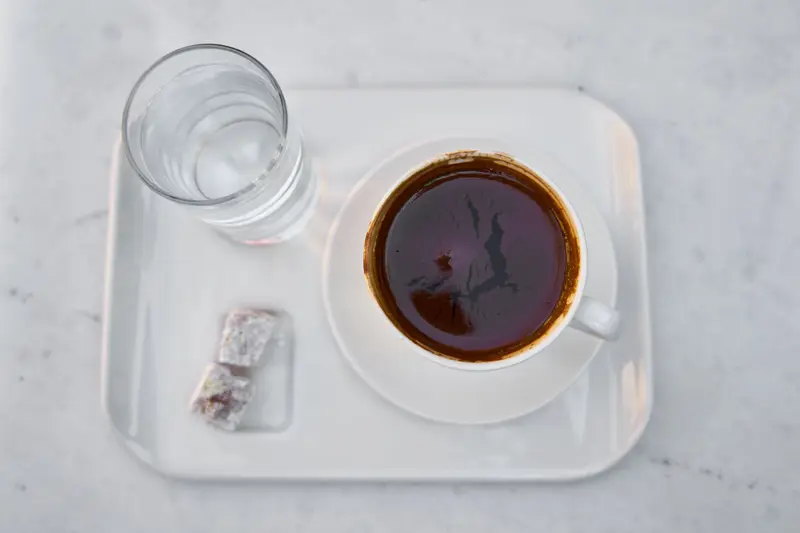
How the coffee is served is part of what UNESCO recognized when it inscribed Turkish coffee culture and tradition in 2013. Its description treats the drink as a symbol of hospitality and friendship, served in small cups with a glass of water, and passed on within families by watching and taking part. A few details show care, and this guide lists them.
What do you need to serve Turkish coffee properly?
A proper service has five parts: a small cup with a saucer, a glass of water, a small sweet, a tray to carry them, and coffee brewed to each guest's sugar preference with foam on top. Everything arrives together, so the guest has water and something sweet at hand from the first sip.
| Item | Details | Why |
|---|---|---|
| Cup, fincan (fin-JAHN) | About 60 to 70 ml (2 to 2.4 fl oz), with a handle, on a saucer | Small volume keeps the coffee hot and matches the recipe |
| Water | A small glass, room temperature or cool | To clear the palate before the coffee |
| Sweet | One or two pieces of lokum (Turkish delight), a chocolate or a date | Balances the coffee's bitterness |
| Tray | Any small tray. Round metal trays are traditional. | Lets you carry and offer everything at once |
| Coffee | Brewed fresh, sugar cooked in, foam shared between cups | See how to make Turkish coffee |
You do not need a matching set. Espresso cups, small glasses and a plain tray do the job.
What size is a Turkish coffee cup?
A Turkish coffee cup holds roughly 60 to 70 ml, about 2 fl oz, which is close to an espresso cup. Published descriptions run from about 50 ml at the small end to as much as 120 ml for some modern sets. Measure your own cups, because the brewing recipe is built on the cup's volume.
The lower range comes from a 2023 survey of Turkish coffee styles in the Journal of Ethnic Foods, which describes the standard cup as smaller than other coffee cups, with one handle, at about 50 to 70 ml. The Daily Sabah gives a wider span of 60 to 120 ml and points out that the thin walls help the coffee come down to a drinkable temperature while the grounds settle.
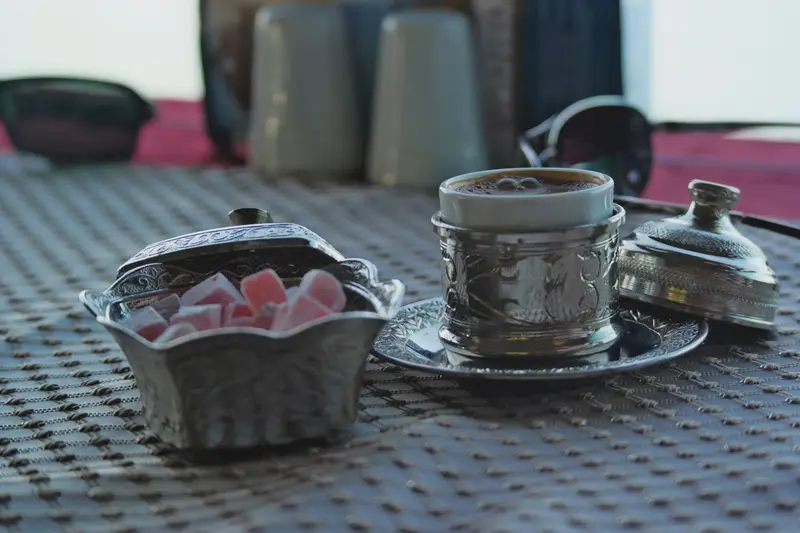
Porcelain is the usual material. Traditionally, older and more formal sets use handleless cups that sit in a metal holder called a zarf (ZARF), sometimes with a lid to keep the coffee warm. Some regional styles break the rule altogether and are served in tea glasses, as the same survey notes.
To match cup and recipe, fill the cup with water and pour it into your cezve (JEZ-veh), the small pot many English speakers call an ibrik. That is the traditional measure, and it is the first step in Kurukahveci Mehmet Efendi's instructions. Wash cups with an unscented soap and rinse them well, as the same roaster's care notes advise, since perfume or detergent residue shows up in a drink this small.
Why is Turkish coffee served with water?
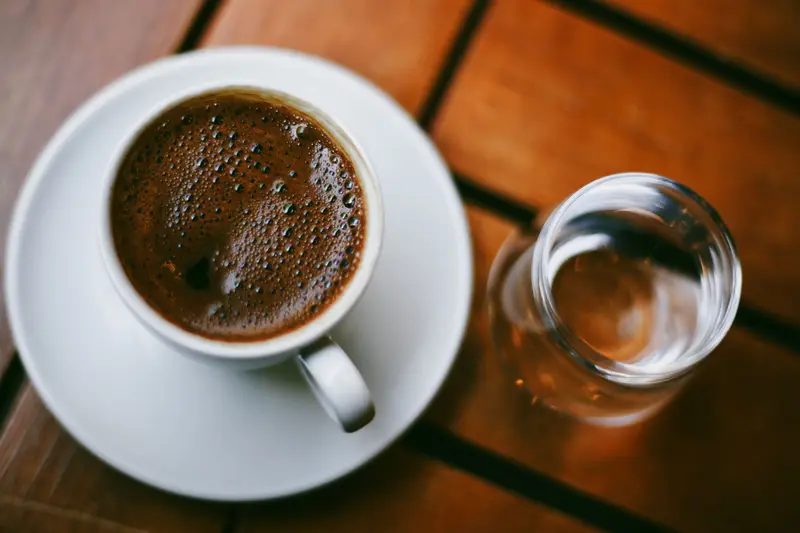
The water is there to clear your palate before the coffee, so the first sip tastes of coffee and nothing else. Drink some of it first. That is the explanation given by Türkiye's tourism portal and by most hosts. Sipping more water afterward is fine too.
GoTürkiye describes the glass of water as something drunk before the coffee to refresh the palate. Kurukahveci Mehmet Efendi says much the same, that the water prepares the mouth for the coffee's flavor. A tour advisor in Turkey quoted by Popular Science recommends drinking the water before the coffee as a palate cleanser.
There is also a well-known folk story. The Daily Sabah relays it as hearsay: a guest who reached for the water first was understood to be hungry, and the host would bring food, while a guest who went straight to the coffee was taken to have eaten. Treat it as a charming tale and not as documented history.
What do you serve with Turkish coffee?
Lokum, or Turkish delight, is the classic partner: a small, soft sweet that offsets the coffee's bitterness. Chocolate, dates, a small cookie or a piece of baklava also work. Keep the portion to one or two bites. The sweet accompanies the coffee and should not compete with it.
Lokum (loh-KOOM) is a confection made mainly from starch, sugar and water, often flavored with rose, lemon or mastic, or filled with pistachios or hazelnuts. Both GoTürkiye and the Journal of Ethnic Foods survey describe it as part of traditional service. The survey adds that offering a well-liked sweet reflects well on the host.
When to eat it is up to the guest. The Daily Sabah passes on another piece of folklore: eating the lokum after the coffee was said to signal that the guest was pleased.
One style is worth knowing if a guest asks for coffee "on the side." In what the survey calls yandan çarklı service, the coffee is brewed plain and the sugar or lokum is served beside it, to be taken in the mouth as you sip. It is a neat solution when guests want different sweetness and you have one pot.
In what order do you serve Turkish coffee to guests?
Ask everyone's sugar preference first, brew, then follow the common custom: guests before family, elders before younger people, and the host last. Offer the tray so each person can take a cup. Many hosts turn the handle toward the guest's right hand and keep the water and sweet within reach.
A workable sequence for hosting at home:
- Ask before you brew. Sugar is cooked into the coffee, so each guest chooses in advance: sade (no sugar), az şekerli (a little), orta (medium) or şekerli (sweet). Amounts are in the recipe guide.
- Group the orders. Brew cups of the same sweetness together. With one cezve, make the unsweetened pot first, then the sweeter ones, so you do not have to wash the pot in between.
- Set the tray while the coffee heats. Saucers, water glasses and sweets go on first.
- Share the foam. Spoon foam into every cup before pouring so nobody gets a bare cup. See the foam guide.
- Carry it out right away. Foam fades within minutes.
- Serve the eldest or the guest of honor first. Then the other guests, then family, then yourself.
- Remember who ordered what. Arrange cups on the tray in a fixed order by sweetness, and tell guests which is which as you offer them.
Serving elders first is a courtesy shared across the region. UNESCO's description of Arabic coffee states that older people and guests are served first, and Abu Dhabi's culture authority says the same of the most important or oldest guest. In Turkish homes the same respect for age is traditionally observed, and it is on show in the best-known coffee ritual of all, described below.
How do you drink Turkish coffee?
Drink some water, wait a minute or two for the grounds to settle, then sip slowly without stirring. Stop when you reach the thick layer at the bottom, usually the last sip or two. Turkish coffee is meant to be lingered over. It is not drunk in one go like an espresso at a bar.
Step by step:
- Water first. A sip or two clears your palate.
- Wait. Kurukahveci Mehmet Efendi notes that the coffee must stand briefly after serving so the grounds sink. 2013 World Cezve/Ibrik Champion Turgay Yıldızlı's recipe suggests one to two minutes.
- Do not stir. The sugar is already dissolved, and a spoon would lift the grounds. This is why the cup is usually served without a spoon.
- Sip, do not gulp. Small sips keep the settled layer undisturbed, and the coffee is hot.
- Leave the last sip. The grounds at the bottom, called telve (TEL-veh), are not meant to be drunk. When the coffee starts to feel thick, you are done.
- Do not add milk or sugar afterward. If it is not sweet enough, take a bite of lokum with it.
For how much caffeine is in the cup, see Turkish coffee caffeine.
What other customs go with Turkish coffee?
Three customs come up most: reading fortunes in the grounds, the coffee served during an engagement visit, and the general rule that coffee is an invitation to sit and talk. Guests are not expected to know any of them, and hosts are happy to explain.
Fortune reading. After the last sip, the cup can be turned upside down on its saucer and left to cool, and the patterns the grounds leave are read for fun. UNESCO's description mentions the practice. Our guide to Turkish coffee fortune telling explains how it is done.
The engagement visit. When a suitor's family visits to ask for a bride's hand, the bride-to-be traditionally prepares and serves the coffee to the suitor and his elders, and her care in making and serving it is noticed, as GoTürkiye describes. A famous comic twist has her salting the groom's cup. The Daily Sabah reports the old version of the story, in which salt signaled reluctance, as rumor, and notes that today it is a lighthearted joke.
Coffee as conversation. In UNESCO's description, friends who invite each other for coffee are making time for close conversation about everyday matters. As a guest, the polite thing is to stay for the cup. As a host, do not clear cups quickly. A cup left on the table is a reason to keep talking.
Neighboring habits. Greek, Armenian, Bosnian and Arab homes that brew the same style of coffee have their own names, sweets and order of things. As a guest, follow your host. See Turkish vs Greek vs Arabic coffee.
How do you order and drink it at a coffee shop?
State your sugar level when you order, since it cannot be changed afterward. Expect a small cup, a glass of water and often a sweet. Let the cup rest, sip slowly and leave the grounds. If you want to see how a practiced hand serves it, that is the best lesson there is.
Useful words when ordering: sade (sah-DEH) for no sugar, orta (or-TAH) for medium, şekerli (sheh-ker-LEE) for sweet. More terms are in the glossary.
The Turkish Coffee Map of America lists verified US coffee shops and restaurants that serve cezve-style coffee in the Turkish, Greek, Arabic, Armenian, Bosnian and Yemeni traditions.
Where to go next
- Brew it well first: how to make Turkish coffee
- Choose the pot: cezve and ibrik guide
- Choose the coffee: best coffee for Turkish coffee
Sources
- UNESCO Intangible Cultural Heritage: Turkish coffee culture and tradition (inscribed 2013)
- GoTürkiye (Türkiye Tourism Promotion and Development Agency): Turkish coffee
- Journal of Ethnic Foods (2023): Spatial distribution of Türkiye's local Turkish coffee kinds
- Daily Sabah: Turkish coffee, crown of Türkiye, best mate of Turkish delight (January 24, 2023)
- Kurukahveci Mehmet Efendi: brew guide, Turkish coffee with cezve
- Kurukahveci Mehmet Efendi: Turkish coffee, definition and history
- Kurukahveci Mehmet Efendi: useful information
- Popular Science: How to enjoy the flavor, history, and science of Turkish coffee
- European Coffee Trip: Make Turkish coffee the specialty way (recipe by Turgay Yıldızlı)
- UNESCO Intangible Cultural Heritage: Arabic coffee, a symbol of generosity
- Abu Dhabi Culture (Department of Culture and Tourism): Gahwa, Arabic coffee
Questions people ask
Do you drink the grounds in Turkish coffee?
No. The grounds settle into a thick layer at the bottom of the cup and are left there. Stop drinking when the coffee turns muddy, usually with a sip or two remaining. Swallowing a little by accident is harmless, just unpleasantly gritty.
Do you drink the water before or after Turkish coffee?
Before. The water clears your palate so you taste the coffee fully, which is the explanation given by Türkiye's tourism portal and by traditional roasters. Having more water afterward is perfectly acceptable, and many people do.
Can you add milk or sugar to Turkish coffee after it is served?
Sugar is added before brewing, never after, because stirring the cup would raise the grounds. Milk is not part of the traditional drink. If the coffee is less sweet than you like, eat the lokum or sweet that comes with it between sips.
How many cups of Turkish coffee is it polite to accept?
One cup is customary, and accepting it is the courteous response to a host's offer. A second cup is fine if it is offered and you want it. If you prefer to avoid caffeine, it is acceptable to say so and take water or tea.
What can I serve instead of Turkish delight?
Any small sweet works: a square of dark chocolate, a date, a piece of baklava, a shortbread cookie or sugared almonds. The aim is one or two bites of sweetness to balance the coffee. Avoid strongly scented or very large desserts.
Is Turkish coffee served after a meal or in the afternoon?
Both are common. It is often served after a meal, especially to guests, and as a mid-morning or afternoon break with conversation. There is no fixed hour. Because the cup is small and strong, people who are sensitive to caffeine may prefer it earlier in the day.