Guide
Turkish coffee fortune telling: how to read a coffee cup
Turkish coffee fortune telling, called fal, is the custom of reading the shapes that coffee grounds leave inside a cup. After drinking, you cover the cup with its saucer, turn it over, let it cool, and a friend interprets the patterns. It is folklore and entertainment, a reason to keep talking after the coffee is gone.
By Ahmet Kırtok · Updated November 26, 2026 · 8 min read
What is Turkish coffee fortune telling?
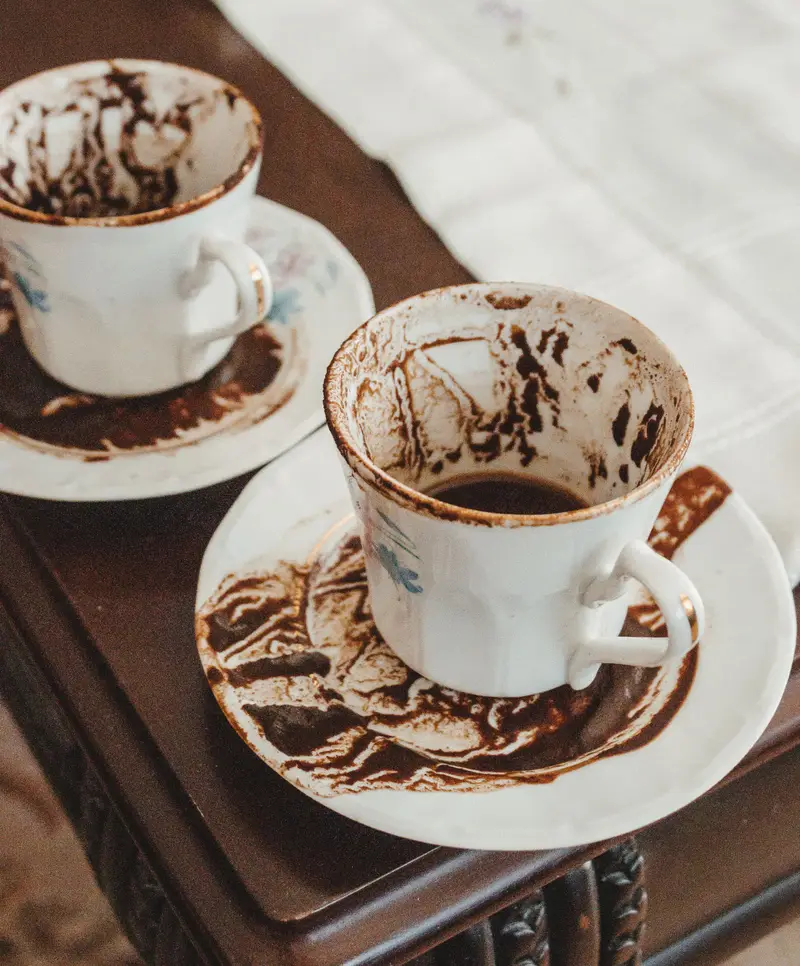
It is a social custom in which one person reads another's finished coffee cup. The Turkish name is kahve falı (kah-VEH fah-LUH), or simply fal. The English term for reading cups is tasseography. The reader looks at the trails and clumps the grounds have left and turns them into a story about the drinker's life.
The custom is part of what UNESCO recognized in 2013 when it inscribed Turkish coffee culture and tradition. UNESCO's description notes that the grounds left in the cup are often used to tell a person's fortune. Türkiye's Ministry of Culture and Tourism describes the ritual in more detail and is clear about its spirit: the shapes are interpreted as a form of entertainment.
That is how to approach everything on this page. A Turkish saying sums up the attitude: Fala inanma, falsız da kalma. Do not believe in fortunes, but do not go without one either. Nobody at the table needs to believe a bird in the cup will bring a letter. The reading gives friends a playful way to talk about hopes, worries and what might come next.
Cup reading is also a familiar custom in other places where this coffee is drunk, such as Greece, Armenia, the Balkans and parts of the Arab world. Meanings and rules shift from one family to the next.
Why does it only work with Turkish coffee?
Cup reading depends on grounds, and Turkish coffee is the method that leaves them in the cup. The coffee is unfiltered, so a layer of fine sediment settles at the bottom. When the cup is turned over, that sediment slides down the walls and dries into patterns.
Filtered coffee and espresso leave nothing to read. The grind matters as well. Powder-fine coffee makes a smooth mud that draws clear lines and shapes, while a coarser grind gives a few scattered specks. If your cups come out blank, see Turkish coffee grind and brew according to how to make Turkish coffee.
A plain white cup with a rounded interior shows patterns best. The cup should be drunk from one side only, and the drinker should leave the last sip, grounds and all.
How do you turn the cup?
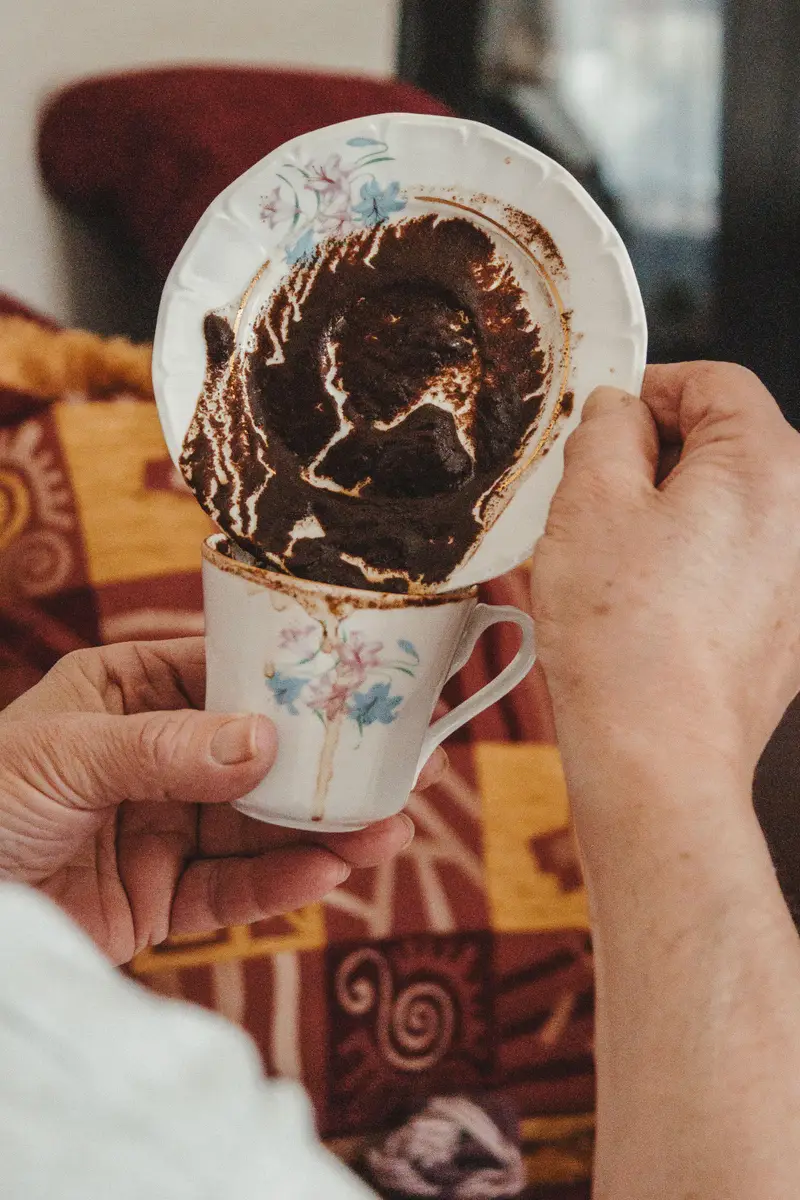
When the coffee is finished, place the saucer upside down on top of the cup, make a wish, swirl gently, and flip cup and saucer together so the cup ends up inverted. Then leave it alone until the bottom of the cup feels cool, usually five to ten minutes.
The details, as most families do it:
- Leave the last sip. You need a spoonful of liquid with the grounds for them to flow.
- Cover the cup. Put the saucer on top like a lid.
- Make a wish. Hold the cup at chest height. This is the customary moment for a silent wish or question.
- Swirl. Give the covered cup two or three slow circles so the grounds coat the walls.
- Flip. In one steady motion, turn the cup and saucer over together, toward yourself in many households. Set them down.
- Wait. Let the cup cool completely. A warm cup means the grounds are still moving.
Some people rest a ring on the upturned cup if the question is about love, or a coin if it is about money. Some say it helps the cup cool faster. These are small habits, and you can skip them.
How is the cup read?
The reader lifts the cup, looks inside, and describes what the shapes suggest. Most readers follow a loose map: the handle marks the drinker and home, the rim stands for the near future, and the depths of the cup hold the more distant future or the past. The saucer is read last.
Conventions vary from family to family. These are commonly given:
| Part of the cup | Common convention |
|---|---|
| Area near the handle | The drinker, home and family |
| Opposite the handle | The outside world, work, strangers |
| Near the rim | Events coming soon |
| Middle of the wall | The coming weeks or months |
| Bottom of the cup | The distant future, or the past and what weighs on the heart |
| Light, open areas | Ease, relief, good news |
| Dark, heavy areas | Worries or burdens |
| The saucer | Home life, and whether the wish will come true |
If the cup sticks to the saucer when the reader tries to lift it, many say the wish is already granted and the cup need not be read at all. If a large clump of grounds falls into the saucer, troubles are said to be leaving. A drop that runs down the wall as the cup is lifted is sometimes called a tear, read as sadness passing, or as a small sum of money on its way.
A good reader does more than list shapes. They link them into a short story, check it against the drinker's face, and leave the person feeling a little lighter than before.
What do the symbols in a coffee cup mean?
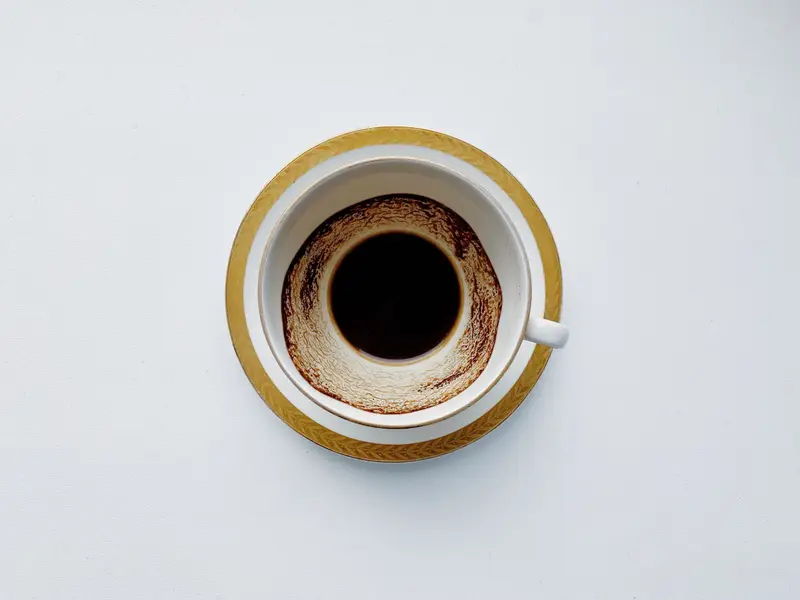
Each shape has a traditional meaning, and meanings vary between families and regions. The table lists common readings in Turkish folklore. Treat them as a starting vocabulary for a game. None of them predicts anything.
| Symbol | Traditional meaning |
|---|---|
| Bird | News on the way; a bird in flight means it comes soon |
| Fish | Good fortune, often money or a lucky opportunity (kısmet) |
| Road or long line | A journey; a clear road is an easy trip, a broken one means delays |
| Ring or circle | Marriage, engagement or a commitment |
| Heart | Love or affection |
| Eye | Envy from others, the evil eye (nazar); a reminder to be discreet |
| Snake | An enemy or someone untrustworthy |
| Horse | A wish coming true, or a visitor arriving |
| Tree | Health, growth, a long-term plan taking root |
| Mountain | An obstacle; a path over it means you will cross it |
| Key | A solution, a new home or an opening door |
| Star | Success, a wish fulfilled |
| Moon | Calm and happiness; a crescent suggests a new beginning |
| Sun | Joy, a bright period |
| Flower | Happiness, a pleasant surprise |
| Dog | A loyal friend |
| Cat | A quarrel or a false friend |
| Rabbit | Timidity; a call for courage |
| Butterfly | Short-lived pleasures, flirtation |
| Candle | Hope, help from someone |
| Letter or envelope | A message |
| Ship or boat | Travel or a welcome arrival |
| Door or gate | A new opportunity |
| Bridge | A transition, crossing from one stage to another |
| Triangle | Unexpected luck |
| Square | Stability and protection |
| Numbers and letters | A time span (days, weeks) or an initial of someone important |
Size and position change the reading. A large, clear shape is given more weight than a faint one. A shape near the handle concerns the drinker closely, and one on the far side concerns other people. Two shapes together are read as a pair: a bird beside a road is news from far away.
Seeing shapes is a skill that grows with practice. Turn the cup slowly under good light, look at both the dark grounds and the white spaces between them, and say what you see first. There are no wrong answers at a kitchen table.
What is the etiquette of a coffee reading?
The rules are light, and their purpose is to keep the reading kind. Someone else reads your cup, the reader keeps the tone warm, and nobody is frightened or embarrassed. A reading is a gift from one friend to another.
Customs you will meet in most homes:
- Do not read your own cup. A friend, relative or neighbor does it.
- Drink from one side. It keeps the pattern clean.
- Wait for the cup to cool. Lifting early smears the shapes and is considered impatient.
- Good news first, bad news gently. Many readers will not voice anything about illness or death. Follow that example.
- Keep private things private. If the reading wanders toward something personal, save it for a quieter moment.
- The opening line. Readers often begin with Neyse halin, çıksın falın: whatever your state is, let it show in your fortune.
- Do not repeat a reading. One cup, one reading. Brewing another cup to get a better fortune misses the point.
- Do not pay a friend. Among friends a reading is free. Thank the reader, and offer to read theirs.
Some people decline readings for religious or personal reasons. Respect that without comment, and never press a guest to turn their cup.
One practical caution belongs here too. Fortune telling is entertainment. It is not a basis for decisions about health, money, relationships or legal matters, and you should be wary of anyone who charges large sums or claims to remove curses.
How can you try cup reading with friends?
Brew a pot of Turkish coffee, serve it in white cups, drink slowly, turn the cups and take turns reading each other's. Plan about 40 minutes for four people from first sip to last reading. You need no experience, only the symbol table above and a willingness to tell a story.
A step-by-step for a first evening:
- Set up. You need powder-fine coffee, a cezve (the pot many English speakers call an ibrik), small white cups with saucers, and good light.
- Brew and serve. Make the coffee without rushing and serve it with water. Our serving guide covers the table.
- Drink and talk. Sip from one side. Stop when you reach the thick part.
- Turn the cups. Saucer on top, wish, swirl, flip. Everyone does this together.
- Wait five to ten minutes. Touch the base of the cup. When it is cool, it is ready.
- Pair up. Swap cups with the person next to you.
- Read the cup. Start at the handle and move around the wall. Name three shapes, say where they sit, and connect them into two or three sentences.
- Read the saucer. Look at what dripped down. Say whether the wish looks likely.
- Close kindly. End on the best thing you saw.
- Swap roles. The reader's cup is read next.
If it goes well, make it a habit. If you would rather have the coffee made for you, find a place on our map. Some hosts and coffee shops offer readings as part of the experience, and it is always fine to ask.
For the wider story of how this coffee and its customs developed, see the history of Turkish coffee. New words are explained in the glossary.
Sources
Questions people ask
Is Turkish coffee fortune telling real?
It is a real and old custom, and it has no power to predict events. No evidence supports that. People read cups for fun and for conversation, and Türkiye's culture ministry describes the practice as a form of entertainment.
How long should the cup cool before reading?
Usually five to ten minutes, until the base of the inverted cup feels cool to the touch. A cup that is still warm has wet grounds that keep sliding, so the shapes are not yet settled. Thicker porcelain takes a little longer.
Can I read my own coffee cup?
Tradition says no. The custom is that someone else reads for you, which is part of what makes it social. If you are alone and curious, nothing stops you from looking, but most people save it for company.
What does it mean if the cup sticks to the saucer?
In common folklore a cup that clings to its saucer means the drinker's wish will come true, and many readers will leave it unread. A likely practical explanation is that thick, cooling grounds seal the rim against the saucer.
Do I need a special cup for coffee reading?
No. Any small cup works, though a plain white interior with curved walls shows the patterns most clearly. Cups with straight sides or dark glazes are harder to read. A matching saucer is needed for turning the cup over.
Can you read fortunes from Greek or Arabic coffee?
Yes, when it is the unfiltered kind with grounds in the cup. Greek, Armenian, Bosnian and Levantine coffee all leave the same sediment, and cup reading is commonly practiced in those communities too. Gulf qahwa is poured clear and leaves nothing to read.