Blog post
How to order Turkish coffee: sugar levels, what to say and what arrives
Order Turkish coffee by sugar level, because the sugar is cooked into the pot and cannot be stirred in later. Say sade for none, az şekerli for a little, orta for medium or şekerli for sweet. A small cup arrives with a glass of water, foam on top and grounds at the bottom that you leave behind.
By Ahmet Kırtok · Updated November 26, 2026 · 5 min read
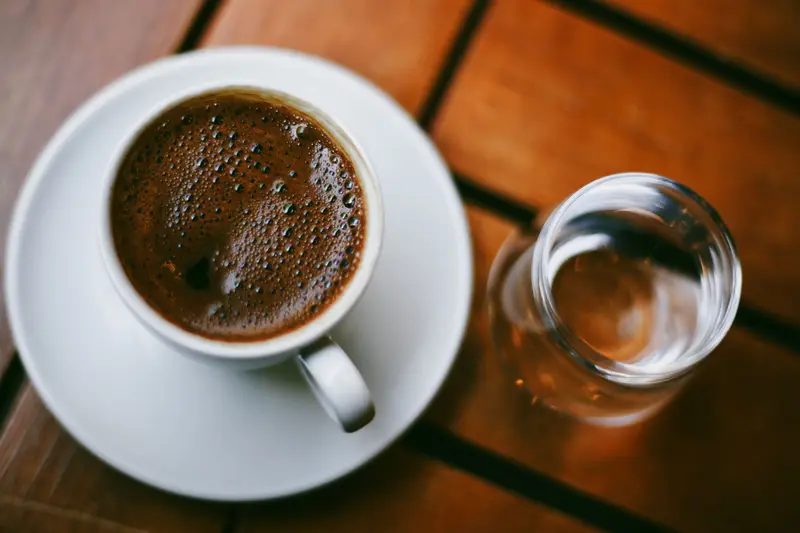
Why do you have to choose the sugar when you order?
The sugar is added to the pot with the coffee and water before it goes on the heat, so it dissolves during brewing. Stirring a finished cup would lift the grounds off the bottom and break the foam. That is why the server asks about sugar first and why the question can't wait.
UNESCO's description of the tradition lists the ingredients going into the pot together: finely ground coffee, cold water and sugar, brewed slowly until foam forms. The pot is a cezve (JEZ-veh), which many English speakers know as an ibrik. Our step-by-step brewing guide covers the method. This post is only about what happens on the customer's side of the counter.
What are the Turkish coffee sugar levels called?
There are four standard levels, and one word is enough to order. Sade means no sugar, az şekerli means a little, orta means medium, and şekerli means sweet. If you say nothing, you will usually be asked. Some US menus print the levels: Agora DC in Washington lists sade, az şekerli, orta şekerli and çok şekerli.
| What you say | Rough pronunciation | What you get |
|---|---|---|
| Sade | sah-DEH | No sugar. The coffee's own bitterness and aroma, nothing else. |
| Az şekerli | ahz sheh-kehr-LEE | A little sugar. Takes the edge off without tasting sweet. |
| Orta | or-TAH | Medium. The default many people start with. |
| Şekerli | sheh-kehr-LEE | Sweet. Sometimes called çok şekerli (very sweet). |
Exact spoon amounts vary from one coffee shop and one household to the next, so treat the words as a scale and adjust on your second visit.
What should a first-timer order?
Orta is the safe first order if you normally sweeten coffee, and sade if you drink espresso or black coffee without sugar. The cup is small and concentrated, and the sugar level changes the character of the drink more than it does in a large filter coffee.
If the menu offers more than one style, such as coffee brewed in hot sand or with cardamom, ask what the house version is before choosing. Staff in places that take this coffee seriously tend to enjoy the question.
What arrives at the table?
Expect a small cup, filled close to the rim, with a layer of foam on top and a glass of water beside it. Many places add a small sweet such as a piece of Turkish delight. The coffee is unfiltered, so the grounds are in the cup and settle to the bottom while you wait.
UNESCO's entry on Turkish coffee culture mentions the small cups and the glass of water specifically. The foam, called köpük (kuh-PUEK), is a sign that the coffee was brewed with care and poured gently; our foam guide explains how it forms. For why the water and the sweet are there, see why Turkish coffee is served with water and Turkish delight.
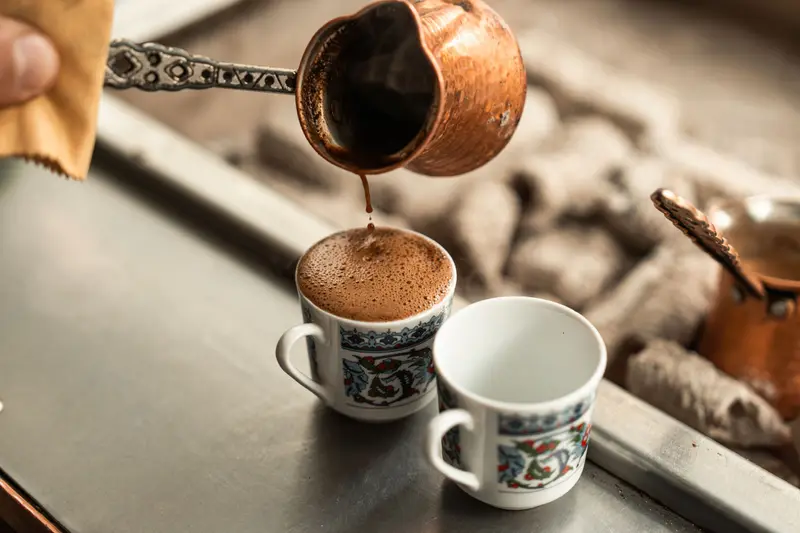
How do you drink it without getting a mouthful of grounds?
Wait a minute or two after the cup arrives, then sip slowly and stop when the liquid turns thick. Do not stir. The last quarter inch or so of the cup is telve (TEL-veh), the settled grounds, and it stays in the cup.
- Take a sip of water first if you like. A 2018 review in the journal Turkish Studies says the water is there to cleanse the mouth before the coffee.
- Let the cup sit for a minute or two so the grounds sink.
- Sip from the top. The foam comes first.
- Stop when you feel grit. That is the end of the coffee.
Nobody will be offended if you leave the bottom of the cup. Leaving it is the correct way to finish. In some company, the cup is then turned over on its saucer for a fortune reading, which our fortune-telling guide explains.
How do you order at a Greek or Arab restaurant?
The method is shared, and so is the habit of ordering by sweetness. Only the words change. A Greek restaurant or bakery will understand sketos, metrios and glykos. At an Arab coffee house the same choices apply, and since the words vary by country, asking in English for no sugar, medium or sweet works everywhere.
| Sweetness | Turkish | Greek |
|---|---|---|
| None | sade | sketos |
| Medium | orta | metrios (about one teaspoon of sugar) |
| Sweet | şekerli | glykos (about two teaspoons) |
| Very sweet | çok şekerli | variglykos |
Names for the drink itself differ too: Greek coffee, Armenian coffee, Bosnian coffee, Arabic coffee. Order it by the name on the menu in front of you. Our comparison of Turkish, Greek and Arabic coffee covers what actually differs between them and describes the naming question neutrally.
What else is worth knowing before you order?
A few practical points save confusion: milk is not part of the traditional drink, the coffee is made to order and takes a few minutes, and one cup is a normal serving. If a place brews a pot for the table, everyone at the table usually shares one sugar level.
- Milk and cream. Traditional Turkish coffee is served without either. Some modern coffee shops offer versions with milk, but ask before assuming.
- Time. A cup brewed properly over low heat is not instant. If you are in a hurry, say so.
- Sharing a pot. When several cups come from one cezve, they share one sugar level. Mixed orders mean separate pots.
- Decaf. Rare. If caffeine matters to you, read our caffeine guide first.
To find somewhere to try your first order, start with our map, where every place has been checked for evidence that it serves coffee brewed this way.
Sources
- UNESCO: Turkish coffee culture and tradition (inscribed 2013)
- Agora DC menu, SinglePlatform feed (a US menu that prints the four Turkish sweetness levels)
- Yönet Eren, F. and Ceyhun Sezgin, A. (2018), Kültürel miras açısından Türk kahvesi (Turkish coffee in terms of cultural heritage), Turkish Studies 13/10, pp. 697–712
- Athens Insider: What you need to know about ordering coffee in Greece