Guide
Turkish coffee foam: why it forms and how to get it every time
Turkish coffee foam forms when gas left in the grounds from roasting escapes as the coffee heats, lifting fine particles into a dense layer just before the boil. To get it reliably, use fresh, flour-fine coffee, a small narrow-necked cezve, low heat, one stir at the start, and take the pot off before it boils.
By Ahmet Kırtok · Updated November 26, 2026 · 9 min read
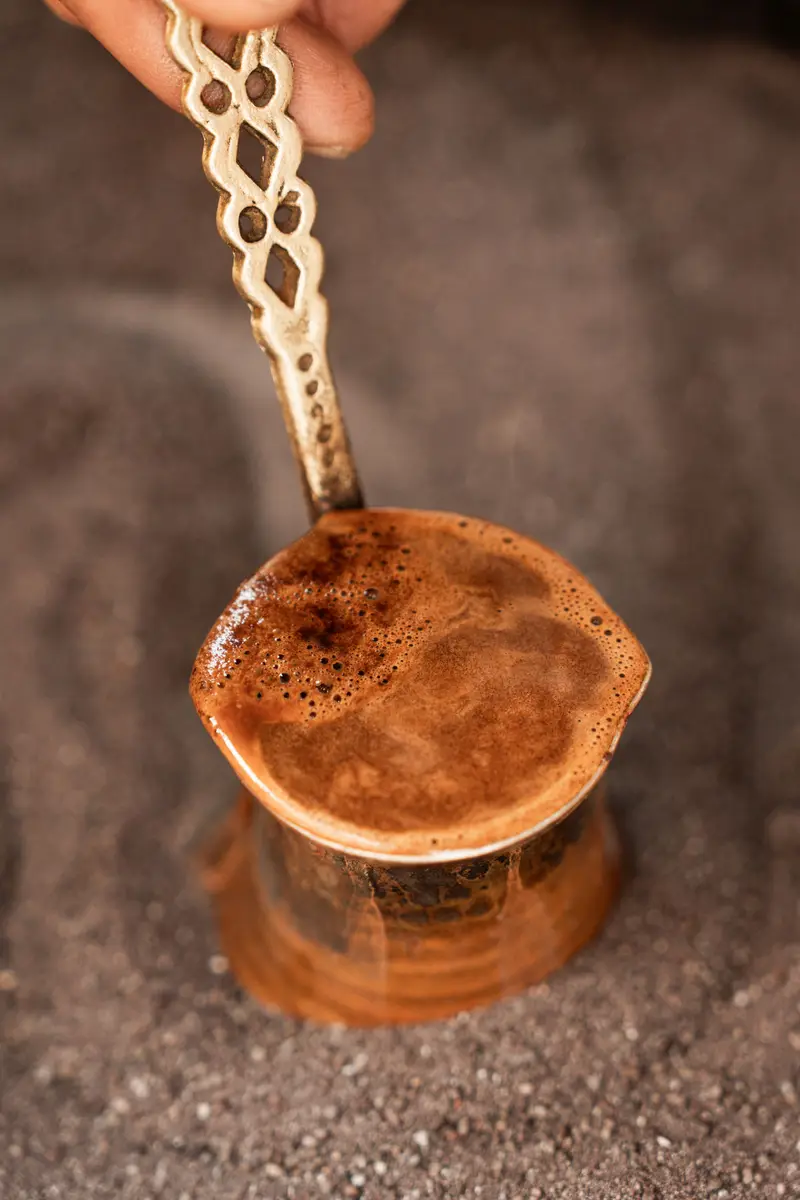
The foam is called köpük (kuh-PEWK) in Turkish. Arabic speakers call it raghweh, Greek speakers kaimaki. In most homes that brew this way, a cup that arrives with a full, unbroken cap is the sign that the person at the stove paid attention. This guide explains what the foam is, how to build it, and how to fix the four problems people run into most.
Why does Turkish coffee foam?
Roasting leaves carbon dioxide and other gases trapped inside coffee. When fine grounds heat up in water, that gas is released, and the bubbles carry tiny coffee particles to the surface, where they gather into foam. The exact mechanics are not fully settled, and a change in surface tension at high temperature is one proposed explanation.
That summary follows Popular Science's reporting, which draws on Peter Giuliano of the Coffee Science Foundation and says plainly that researchers do not completely understand foam formation in this brew. We prefer to pass that uncertainty on honestly. What is well established is the practical side: when foam appears, what destroys it and which conditions favor it.
The foam has jobs beyond appearance. The same article notes that it traps aroma and helps the small cup hold its heat. A 2023 study of Turkey's regional coffee styles makes the same point about heat, and records that foam is generally valued in Turkish coffee culture.
It is a different thing from espresso crema, which is produced under pressure. For that comparison, see Turkish coffee vs espresso.
At what temperature does the foam form?
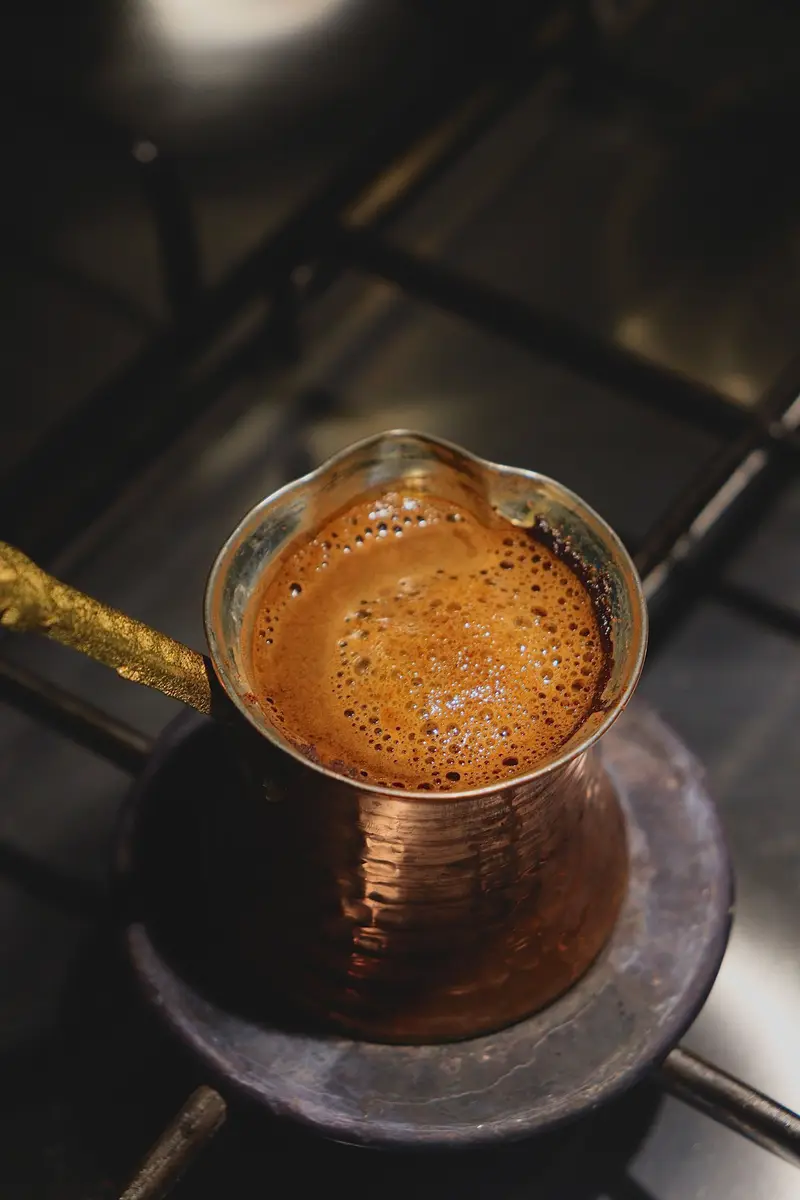
Foam builds in the last stretch before boiling, at roughly 80 to 90 °C (176 to 194 °F). Sources differ by a few degrees: Türkiye's tourism portal places the first rise near 80 °C, and Barista Hustle's cezve course puts the start around 88 °C and advises pouring before 93 °C (199 °F).
| Stage | Approximate temperature | What you see | What to do |
|---|---|---|---|
| Warming | Up to about 60 °C (140 °F) | Still, dark surface | Nothing. Do not stir. |
| Ring | About 70 to 80 °C (158 to 176 °F) | A darker ring at the edge, small bubbles | Watch closely. Lower the heat if it is moving fast. |
| Rise | About 80 to 90 °C (176 to 194 °F) | The ring closes, the surface domes and climbs the neck | Lift off. Spoon foam into the cups. |
| Too far | Above about 93 °C (199 °F), then a boil at 100 °C (212 °F) | Large bubbles break through, foam thins and vanishes | Avoid. Once boiled, foam does not return. |
The first two rows are our own description of what the pot looks like on the way up. The rise and limit figures come from GoTürkiye and Barista Hustle. Barista Hustle also notes that the brew can briefly double in volume during the rise, which is why a pot filled too high ends up on the stove.
You do not need a thermometer. The closing ring and the dome are easier to read than a number.
How do you get thick foam on Turkish coffee?
Thick foam comes from seven habits: fresh coffee, a true Turkish grind, the right size pot, cold water, a single thorough stir, low heat, and removing the pot at the rise. Miss one and the foam thins. Miss two and it usually disappears.
- Use fresh coffee. The foam depends on gas from roasting, and that gas escapes over time, faster once coffee is ground. An old, open bag is the most common cause of a flat cup. See storage advice in the grind guide.
- Use flour-fine grounds. Espresso grind is too coarse to build a stable layer.
- Match the cezve to the batch. The liquid should reach the base of the neck, where the taper gathers the foam into a thick band. See the cezve guide.
- Start with cold water. A slower climb gives the foam time to build.
- Stir once, at the start. Wet all the coffee, dissolve the sugar, then put the spoon down.
- Keep the heat low. A one-cup pot should take around two and a half to four minutes to rise.
- Lift off at the rise. Take the pot from the heat as the foam climbs, before large bubbles break the surface.
Clean equipment helps too. Kurukahveci Mehmet Efendi's care notes stress rinsing pots and cups thoroughly so no cleaning product is left behind. Detergent residue is commonly blamed for flat foam in other drinks too, so that advice is worth following.
How do you get the foam into the cup without losing it?
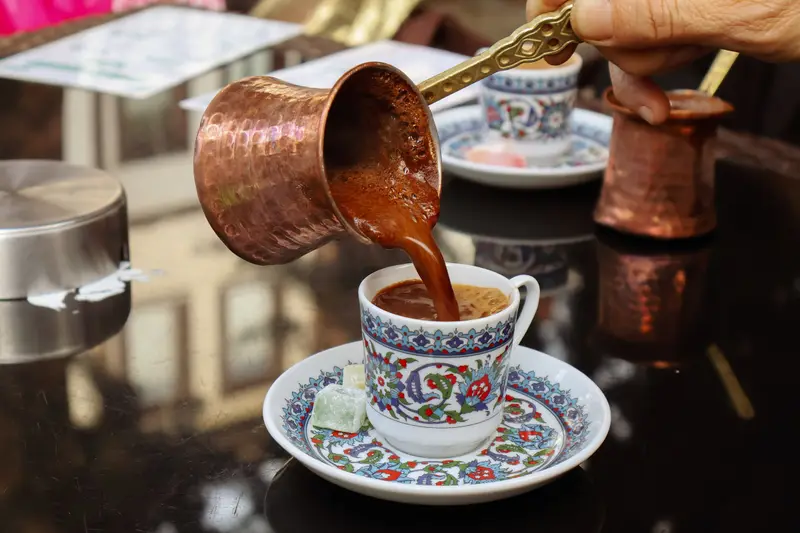
There are two reliable ways. The traditional way is to spoon the first foam into each cup, return the pot for a brief second rise, then pour gently down the side of the cup. The single-pour way is to pour everything slowly, right after the first rise, into a tilted cup.
Spoon and second rise. This is the method in Kurukahveci Mehmet Efendi's instructions: share a little foam between the cups with a teaspoon, bring the pot up again, and fill the cups. It works especially well for several cups, because every guest is guaranteed foam. The Daily Sabah describes dividing the foam before pouring as the way to make sure everyone gets a share.
Single pour. 2013 World Cezve/Ibrik Champion Turgay Yıldızlı's recipe, as published by European Coffee Trip and Fresh Cup, removes the pot once as the foam nears the rim, then pours slowly with the cup held at an angle. It is quicker and suits one or two cups.
Either way, three details protect the foam:
- Pour from low, close to the cup, in a thin steady stream.
- Aim at the inside wall of the cup, not the center.
- For several cups, fill each halfway, then top them all up, so the foam and the strength are shared evenly.
What went wrong? A troubleshooting table
Nearly every foam problem has one of a handful of causes, and each has a direct fix. Find your symptom in the left column. If two causes could apply, change one thing at a time so you know which fix worked.
| Problem | Likely causes | Fix |
|---|---|---|
| No foam at all | Stale coffee. Grind too coarse. Pot far too large for the amount. Stirred during heating. Detergent residue in the pot. | Open a fresh pack or have beans ground to order. Check the grind with the pinch test. Use a cezve where the liquid reaches the neck. Stir only at the start. Rinse the pot well. |
| Foam forms, then collapses in the pot | Left on the heat past the rise. Heat too high, so large bubbles tore through. | Lift off as soon as the surface domes. Lower the burner. If you miss the moment, pull the pot and try a brief second rise on the lowest heat. |
| Foam collapses in the cup | Poured from too high or straight into the center. Cup rinsed with soap and not rinsed well. Coffee past its best. | Pour low and against the cup wall. Spoon foam in first. Rinse cups in plain hot water before serving. |
| Boiled over | Pot overfilled. Heat too high. Attention elsewhere for a few seconds. | Fill only to the base of the neck. Use the smallest burner on low. Stay with the pot from the first ring until it is off the heat. |
| Bitter or harsh | Reached a rolling boil. Brewed too long. Very dark roast. | Remove at the rise. Aim for about three minutes for one cup. Try a medium roast. See best coffee for Turkish coffee. |
| Foam on one cup, none on the others | Poured cup by cup from a full pot. | Spoon foam into every cup first, then fill in two passes. |
| Large, soapy-looking bubbles | Heat too high, or the pot was moved or shaken hard. | Lower the heat and handle the pot gently. Fine, dense foam needs a slow rise. |
| Thin foam with sweet coffee | No single clear cause. Some brewers find heavily sweetened pots foam a little less. | Dissolve the sugar fully in the cold water before heating, and keep the heat low. |
A boil-over is a burn risk as well as a mess. The liquid is close to boiling and sticky with fine grounds. Turn the pot handle away from the edge of the stove, and keep children back while you brew.
Does the heat source or the pot change the foam?
Yes, mainly through speed and shape. Any heat source that raises the temperature slowly and evenly favors foam, and any pot that narrows at the top gathers it. Copper responds quickly when you lower the heat, which makes the critical last seconds easier to manage.
Slow, surrounding heat is the appeal of brewing in hot sand, though claims that sand makes better foam rest on tradition and on makers' own descriptions, not on controlled tests. We look at that evidence in Turkish sand coffee. On a kitchen stove, the smallest burner on low gets you the same slow climb.
A wide saucepan is the hardest vessel for foam, because the layer spreads thin. If that is what you have, see Turkish coffee without a cezve for ways to help it along.
Does everyone want foam?
No. Foam is prized in most Turkish homes and coffee shops, and in Greek, Arab and Balkan practice too, but preferences vary by region and by family. Treat it as the prevailing custom, and ask a guest who grew up with a different habit how they like it.
The Journal of Ethnic Foods survey cited above records that families in Antakya, in southern Turkey, traditionally prefer their coffee without foam, and that some regional styles are deliberately cooked foam-free. Some Arab and Levantine households likewise boil the coffee several times on purpose and serve it with little or none. These are established preferences, and a cup made that way has not gone wrong. For how the neighboring traditions compare, see Turkish vs Greek vs Arabic coffee.
UNESCO's description of Turkish coffee culture and tradition speaks of brewing slowly until the desired foam is produced. "Desired" is the right word. Learn to make a full cap, then make the cup your guest asks for.
Where to go next
- The full method: how to make Turkish coffee
- Presenting the cup: how to serve Turkish coffee
- See a full cap made by a practiced hand: find a place on the Turkish Coffee Map of America.
Sources
- Popular Science: How to enjoy the flavor, history, and science of Turkish coffee (with Peter Giuliano, Coffee Science Foundation)
- Barista Hustle: cezve/ibrik lesson on foam (raghweh)
- GoTürkiye (Türkiye Tourism Promotion and Development Agency): Turkish coffee
- Journal of Ethnic Foods (2023): Spatial distribution of Türkiye's local Turkish coffee kinds
- Kurukahveci Mehmet Efendi: brew guide, Turkish coffee with cezve
- Kurukahveci Mehmet Efendi: useful information
- UNESCO Intangible Cultural Heritage: Turkish coffee culture and tradition
- Daily Sabah: Turkish coffee, crown of Türkiye, best mate of Turkish delight
- European Coffee Trip: Make Turkish coffee the specialty way (recipe by Turgay Yıldızlı)
- Fresh Cup Magazine: Brewing Turkish coffee
Questions people ask
Why does my Turkish coffee have no foam?
The usual causes are stale coffee, a grind that is too coarse, a pot too wide for the amount, or stirring while it heats. Start with the coffee: a freshly opened pack or beans ground to order in a small cezve on low heat fixes most cases.
Should Turkish coffee boil?
It should rise, not boil hard. The foam climbs just below boiling point, and that is the moment to take the pot off the heat. Traditional recipes that say "bring to the boil" mean this foamy rise. A rolling boil breaks the foam and adds bitterness.
Is the foam on Turkish coffee the same as crema?
They look related but form differently. Crema comes from espresso brewed under pressure. Turkish coffee foam forms at normal pressure as gas leaves the grounds near boiling point. Barista Hustle notes its bubbles are slightly larger than crema's, and it fades within a few minutes.
Does sugar affect the foam?
Sugar is cooked in from the start, and it thickens the liquid slightly. We found no reliable published test of its effect on foam. In practice, dissolve it completely during the first stir and keep the heat low, and sweet coffee foams well.
Can I stir to bring the foam back?
No. Stirring breaks the bubbles that remain. If the foam collapsed because the pot boiled, it will not return. If it simply has not formed yet, give it more time on low heat. Next time, lift the pot sooner.
How long should the foam last in the cup?
Expect a few minutes. Barista Hustle's course notes that the foam holds for a short while after serving and then begins to break up. That is normal. Serve right after pouring, and remember the cup needs a minute or two for the grounds to settle anyway.