Blog post
Why Turkish coffee is served with water and Turkish delight
The glass of water is there to clear your palate, and the written sources we found say to sip it before the coffee. The small sweet, often Turkish delight, balances a strong cup that may have been brewed without sugar. Popular stories about secret signals between host and guest are folklore, and worth knowing as such.
By Ahmet Kırtok · Updated November 26, 2026 · 5 min read
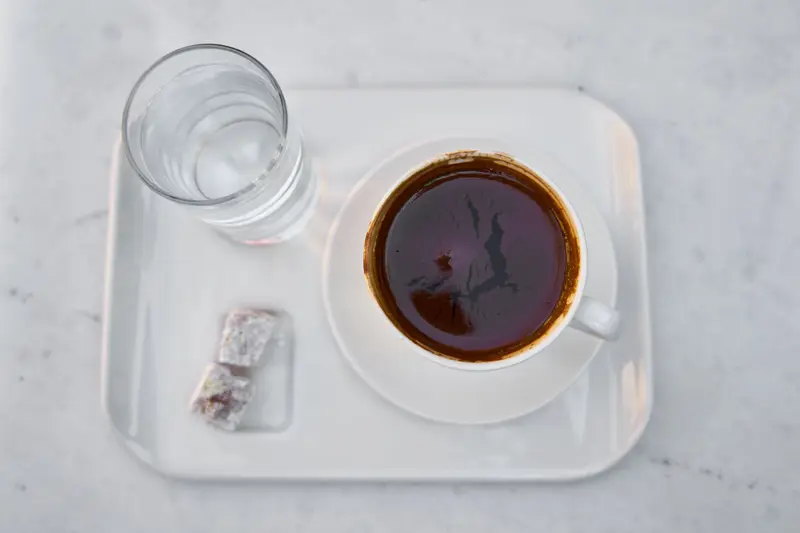
Is the water really part of the tradition?
Yes. The glass of water is documented in the most authoritative description we have. UNESCO's 2013 entry for Turkish coffee culture and tradition says the coffee is served in small cups accompanied by a glass of water. The sweet on the side is common but is not mentioned there.
That distinction matters if you care about what is tradition and what is habit. Water belongs to the core service. The sweet is a widespread courtesy that changes with the house, the region and the occasion. A coffee shop that brings coffee and water with nothing else has left nothing out.
Do you drink the water before or after the coffee?
Before, according to the written guidance we found. The usual explanation is that a sip of water clears whatever you last ate or drank, so the first taste of coffee arrives on a clean palate. A 2018 review of Turkish coffee as cultural heritage, in the journal Turkish Studies, says the water is there to cleanse the mouth before the coffee is tasted, and Daily Sabah reports the same explanation.
In practice people do both, and nobody will correct you. Turkish coffee is unfiltered, and a fine layer of grounds can linger in the mouth after the last sip. A little water afterward helps with that too. If you want one rule to follow, take a sip first, drink the coffee slowly, and finish the glass at the end.
Whether the water is still or sparkling, cold or room temperature, depends on the place. We have not found a credible source that sets a rule.
Why is Turkish delight served with it?
A small sweet softens a concentrated, often bitter cup, and offering one is a gesture of hospitality. Turkish delight, called lokum (lo-KOOM), is the best-known partner, but chocolate, a sugared almond or a spoonful of fruit preserve do the same job.
There is a practical side as well. Sugar is cooked into the pot, so a guest who asked for sade (no sugar) coffee, or who was served a pot brewed for the whole room, has no way to sweeten it afterward. A piece of lokum on the saucer lets each person adjust for themselves. See how to order Turkish coffee for the sugar levels.
We have not found a primary source that dates when the pairing began, so we will not give you a century or a sultan. What can be said safely is that the pairing is established today: the 2018 Turkish Studies review calls lokum an indispensable part of serving coffee to guests.
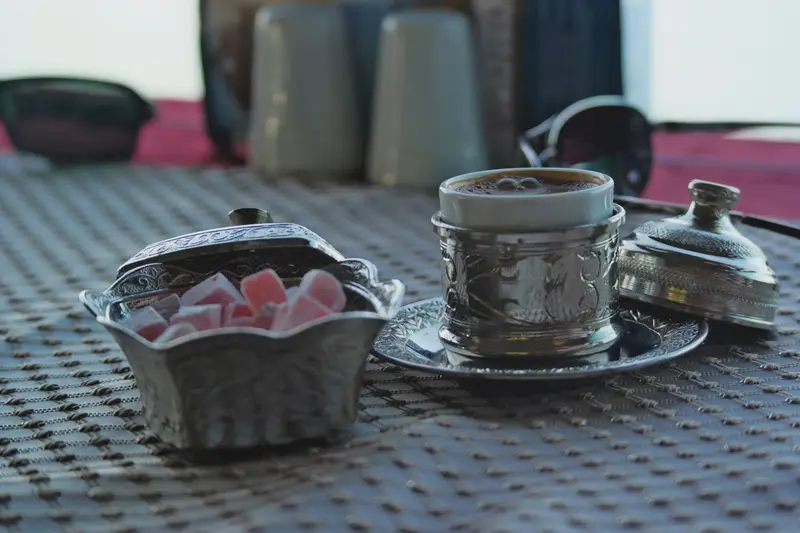
What about the story that the water tests whether a guest is hungry?
It is a well-loved story and should be told as folklore. In the usual version, a host serves water with coffee as a polite question: a guest who reaches for the water first is hungry and should be fed, and a guest who reaches for the coffee first has already eaten.
Turkish newspapers repeat this, and the one we consulted labels it plainly as a rumor. The same article passes on a companion story about lokum: a guest who eats the sweet after finishing the coffee is pleased with the host, and one who leaves it is not.
Neither story has a documented origin that we could find. They are still worth knowing, because people at the table may mention them, and because they say something true about the culture around the cup. Hospitality in this tradition is about noticing what a guest needs before they have to ask.
| Explanation | Status |
|---|---|
| Water is served with the coffee | Documented (UNESCO) |
| Water is sipped first to clear the palate | Stated in a 2018 journal review and in the press |
| A sweet such as lokum often accompanies the cup | Described in the same review; not part of the UNESCO description |
| Water first means the guest is hungry | Folklore, reported as rumor |
| Eating the lokum signals satisfaction with the host | Folklore, reported as rumor |
What do people serve at home?
At home the tray follows the same logic as in a coffee shop: the cup, a glass of water for each guest, and something small and sweet if there is any in the house. Coffee is offered to guests as a matter of course, and UNESCO describes it as a symbol of hospitality and friendship.
If you are serving it yourself, our guide on how to serve Turkish coffee covers cups, trays, order of service and timing. This post is only about the two things that sit beside the cup.
What should you expect at a US coffee shop or restaurant?
Expect the water more often than the sweet. Service varies a great deal between places, and some will bring only the cup unless you ask. Asking for a glass of water with your coffee is a normal request anywhere that brews this style.
If lokum arrives and you have not tried it before, it is a soft, chewy confection, usually cut in cubes and dusted so the pieces do not stick. Common flavors include rose, lemon and pistachio. Eat it between sips or after the cup, as you prefer.
We do not record in our listings whether a place serves water or a sweet, because that changes too often to verify. What each listing does show is a source confirming that the place serves coffee brewed in a cezve, the pot many English speakers call an ibrik. You can browse them on our map.
Does the same custom exist in Greek, Arabic and Balkan coffee service?
The brewing method is shared among Turkey, Greece, the Balkans, Armenia and the Arab world, and each tradition has its own accompaniments. We have verified the water and the sweet only for the Turkish service described here, so we make no claim about the others in this post.
We compare the traditions side by side in Turkish vs Greek vs Arabic coffee, and the terms used here are defined in the glossary.
Sources
- UNESCO: Turkish coffee culture and tradition (inscribed 2013)
- Yönet Eren, F. and Ceyhun Sezgin, A. (2018), Kültürel miras açısından Türk kahvesi (Turkish coffee in terms of cultural heritage), Turkish Studies 13/10, pp. 697–712
- Daily Sabah: Turkish coffee, crown of Türkiye, best mate of Turkish delight