Guide
Turkish coffee glossary: 58 terms explained
This glossary defines 58 words you will meet around Turkish coffee and its relatives: the pots (cezve, ibrik, briki, džezva, dallah), the cup and its contents (fincan, köpük, telve), how to order (sade, orta, şekerli), regional styles, and the customs around the table. Each entry includes a pronunciation hint.
By Ahmet Kırtok · Updated November 26, 2026 · 8 min read
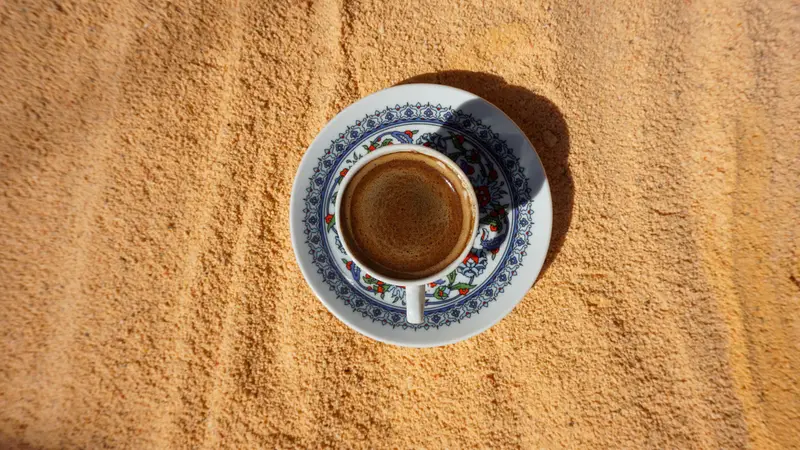
Pronunciations are approximations for American English speakers, with the stressed syllable in capitals. Turkish letters worth knowing: c sounds like English "j," ç like "ch," ş like "sh," ı like the "e" in "open," and ö and ü like the vowels in French peu and tu.
What are the pots called?
The small long-handled pot is the center of this brewing method, and every language that adopted the method renamed it. All the words below describe the same basic tool except the dallah, which is a different vessel for a different style of coffee.
Cezve
(JEZ-veh) The Turkish name for the small, long-handled pot, usually copper or steel, in which Turkish coffee is brewed. It is the primary term on this site. See the cezve and ibrik guide.
Ibrik
(IB-rik) The name many English speakers use for the cezve. In Turkish, ibrik means a ewer or pitcher with a spout, so in Turkey you would ask for a cezve.
Briki
(BREE-kee) The Greek name for the pot used to make Greek coffee. It is the same tool as a cezve.
Džezva
(JEZ-vah) The Bosnian, Serbian and Croatian name for the pot. In Bosnian service the džezva itself is brought to the table on a tray.
Jazzve
(JAHZ-veh) The Armenian name for the pot, also written jezve. Some Armenian speakers call it a srjep.
Rakweh
(RAK-weh) The Levantine Arabic name for the pot, used in Lebanon, Syria, Palestine and Jordan. Also written rakwa.
Kanaka
(KAH-nah-kah) The Egyptian Arabic name for the pot.
Dallah
(DAHL-lah) The tall, long-spouted pot used to pour Gulf-style Arabic coffee. Unlike a cezve, it serves many guests from one pot and pours the coffee clear of grounds.
What are the cup and its parts called?
A Turkish coffee cup is small, usually 60 to 70 ml (about 2 to 2.4 fl oz), and what is inside it has its own vocabulary. These are the words for the cup, the foam on top and the grounds below.
Fincan
(fin-JAHN) The Turkish word for a small coffee cup with a handle, normally served on a saucer.
Finjan
(fin-JAHN) The Arabic word for a small coffee cup. In the Gulf it is a tiny handleless cup, also pronounced finjal, filled about a quarter full.
Fildžan
(FIL-jahn) The small handleless cup used for Bosnian coffee.
Zarf
(ZARF) An ornamental metal holder for a handleless cup, used in the Ottoman period to protect the fingers from heat.
Demitasse
(DEM-ee-tahs) The English and French term for a small coffee cup. A Turkish coffee cup is a demitasse of roughly 2 fl oz.
Köpük
(kuh-PEWK) The dense foam on top of a well-made cup, and a point of pride for the person who brewed it. See Turkish coffee foam.
Kaimaki
(kai-MAH-kee) The Greek word for the foam on Greek coffee.
Wish
(WISH) The Egyptian Arabic word for the foam, literally the "face" of the coffee.
Telve
(TEL-veh) The coffee grounds that settle at the bottom of the cup. They are left undrunk, and they are what is read in a cup reading.
Kahve
(kah-VEH) The Turkish word for coffee, from the Arabic qahwa. It can also mean a coffeehouse.
Türk kahvesi
(TEWRK kah-veh-SEE) "Turkish coffee" in Turkish. See what is Turkish coffee.
How do you say how sweet you want it?
Sugar is cooked into the coffee in the pot, so the sweetness is chosen when you order. Each language has a short set of words for the levels, and the server will ask before brewing.
Sade
(sah-DEH) Plain. Turkish coffee with no sugar.
Az şekerli
(AHZ sheh-ker-LEE) "A little sugar." Lightly sweetened Turkish coffee.
Orta
(or-TAH) Medium. Moderately sweet Turkish coffee, and the most common first order.
Şekerli
(sheh-ker-LEE) "With sugar." Sweet Turkish coffee. Very sweet is çok şekerli.
Sketos
(SKEH-tos) Greek for plain. Greek coffee with no sugar.
Metrios
(MEH-tree-os) Greek for medium. Greek coffee with a moderate amount of sugar.
Glykos
(glee-KOS) Greek for sweet.
Sada
(SAH-dah) Arabic for plain. Unsweetened coffee. It shares a root with the Turkish sade.
Mazbout
(maz-BOOT) Arabic for "just right." Medium-sweet coffee in the Levant and Egypt.
What are the tools and techniques called?
Beyond the pot, a few words describe how the coffee is ground and heated. Grinding to a powder and heating slowly are what set this method apart from every other.
Kahve değirmeni
(kah-VEH deh-eer-meh-NEE) A coffee mill. The traditional Turkish hand mill is a tall brass cylinder that grinds to a powder. See Turkish coffee grind.
Dibek
(dee-BEK) A large stone or wooden mortar in which roasted coffee is pounded with a pestle. Dibek kahvesi is coffee ground this way, with a slightly coarser texture and a mellow taste.
Kumda kahve
(koom-DAH kah-VEH) "Coffee in sand." Coffee brewed by nestling the cezve in a tray of hot sand, which heats the pot gently and evenly. See Turkish sand coffee.
Közde kahve
(kuz-DEH kah-VEH) "Coffee on embers." Coffee brewed slowly over charcoal embers.
Unfiltered coffee
Coffee served without passing through paper or metal, so fine particles and oils remain in the drink. Turkish coffee is the best-known example.
Cafestol
(KAF-eh-stol) A compound in coffee oil, found in higher amounts in unfiltered brews. Unfiltered coffee raised LDL cholesterol in clinical trials. See Turkish coffee caffeine.
Crema
(KREH-mah) The tan foam on espresso, formed by pressure. It is a different thing from köpük. See Turkish coffee vs espresso.
What are the regional styles called?
The same method has many names, and a few related drinks share the table. Use the name the community serving it uses. A full comparison is in Turkish vs Greek vs Arabic coffee.
Ellinikos kafes
(eh-lee-nee-KOS kah-FES) "Greek coffee" in Greek. Brewed in a briki by the same method as Turkish coffee.
Bosanska kahva
(BOH-sahn-skah KAH-vah) Bosnian coffee. The water is boiled first and the coffee added after, and it is served on a tray with sugar cubes.
Haykakan surj
(hai-kah-KAHN SOORJ) "Armenian coffee" in Armenian. Also called sev surj, black coffee.
Qahwa
(GAH-wah or KAH-wah) The Arabic word for coffee. In the Gulf it means lightly roasted coffee boiled with cardamom, served unsweetened from a dallah.
Qishr
(KISH-er) A Yemeni drink brewed from dried coffee cherry husks, commonly with ginger and other spices.
Mırra
(mur-RAH) A very strong, bitter coffee from southeastern Turkey and neighboring Arab regions, boiled down repeatedly and served in tiny amounts. The name comes from the Arabic word for bitter.
Menengiç kahvesi
(meh-nen-GEECH kah-veh-SEE) A caffeine-free drink from southeastern Turkey made from roasted wild pistachio (terebinth) berries, prepared like Turkish coffee, sometimes with milk. It contains no coffee.
Damla sakızlı kahve
(dahm-LAH sah-kuz-LUH kah-VEH) Turkish coffee flavored with gum mastic, a resin with a piney aroma. It is associated with the Aegean coast.
What are the words for people and places?
Coffee created its own institutions and professions in Ottoman cities from the 16th century onward. These words appear in any account of that story. More is in the history of Turkish coffee.
Kahvehane
(kah-veh-hah-NEH) A coffeehouse. The institution spread through Istanbul after the mid-1500s.
Kıraathane
(kuh-rah-aht-hah-NEH) "Reading house." A coffeehouse that offered newspapers and books, common in the late Ottoman period.
Kahveci
(kah-veh-JEE) A person who makes or sells coffee, or who runs a coffeehouse.
Kahvecibaşı
(kah-veh-JEE-bah-shuh) The chief coffee maker of the Ottoman palace or of a great household, responsible for the coffee and its utensils.
What are the words for customs at the table?
The coffee is half the tradition, and the hospitality around it is the other half. These are the words for what is served alongside, what is said, and what happens after the last sip.
Lokum
(loh-KOOM) Turkish delight, a soft confection of starch and sugar. A piece is often served with coffee. See how to serve Turkish coffee.
Rahat lokum
(rah-HAHT loh-KOOM) The fuller name for Turkish delight, used in the Balkans. It comes with Bosnian coffee.
Fal
(FAHL) Fortune telling. Kahve falı is the reading of shapes left by coffee grounds in the cup. See Turkish coffee fortune telling.
Falcı
(fahl-JUH) A fortune teller, or the friend who reads your cup.
Tasseography
(tass-ee-OG-ruh-fee) The English term for reading fortunes from cups, including coffee grounds and tea leaves.
Nazar
(nah-ZAR) The evil eye, the harm believed to come from envy. An eye shape in a coffee cup is read as a sign of it.
Kısmet
(kuss-MET) Fate or good fortune. A fish in the cup is said to promise it.
Tuzlu kahve
(tooz-LOO kah-VEH) "Salted coffee." In the custom of asking for a bride's hand, a playful tradition has the bride-to-be salting the groom's coffee.
Hatır
(hah-TUR) Regard or remembrance. The proverb says a cup of coffee has forty years of hatır: a kindness is remembered for a lifetime.
Afiyet olsun
(ah-fee-YET ol-SOON) "May it do you good." Said when serving food or drink, including coffee.
Kahvaltı
(kah-vahl-TUH) Breakfast in Turkish. The word is commonly explained as kahve altı, "before coffee": the meal eaten before the first cup.
Sources
- UNESCO Intangible Cultural Heritage: Turkish coffee culture and tradition (element 00645)
- Republic of Türkiye Ministry of Culture and Tourism: Turkish coffee culture and tradition
- UNESCO: Decision 10.COM 10.B.32, Arabic coffee, a symbol of generosity (2015)
- Abu Dhabi Culture: Gahwa, Arabic coffee
- Joanna Kakissis, Don't call it 'Turkish' coffee, unless, of course, it is, NPR The Salt (April 27, 2013)
- Saveur: This Michigan coffee shop is bringing Yemeni coffee to the masses (qishr and Yemeni spiced coffee)
- GoTürkiye: Just for the coffee gourmets out there, types of Turkish coffees (mırra, menengiç, dibek, mastic)
- Gross G, Jaccaud E, Huggett AC (1997). Analysis of the content of the diterpenes cafestol and kahweol in coffee brews. Food and Chemical Toxicology 35(6):547-554.
- Niki Gamm, Coffee and coffeehouses among the Ottomans, Hürriyet Daily News (December 26, 2014)
Questions people ask
What is the difference between a cezve and an ibrik?
In English they usually mean the same small coffee pot. Cezve is the Turkish word for it. Ibrik in Turkish means a spouted pitcher, but the word stuck to the coffee pot in English and in some other languages.
How do you pronounce cezve?
JEZ-veh is the usual English approximation. The Turkish letter c is pronounced like the English "j." Bosnian džezva and Armenian jazzve are close cousins of the same word.
What does sade mean on a Turkish coffee menu?
Sade means plain: coffee brewed with no sugar. The other common choices are az şekerli (a little sugar), orta (medium) and şekerli (sweet). You choose before brewing because the sugar is cooked in the pot.
What is the sludge at the bottom of Turkish coffee called?
It is called telve in Turkish. These are the fine coffee grounds that settle after pouring. You leave them in the cup, and they form the patterns used in coffee cup reading.