Guide
Turkish coffee grind: how fine it should be and how to get it
Turkish coffee is ground finer than any other brewing style, to a powder that feels like flour and leaves no grit between your fingers. Published measurements put most particles near or under 100 microns. Few home grinders reach it, so a Turkish hand mill, a capable burr grinder or fresh pre-ground coffee are the practical routes.
By Ahmet Kırtok · Updated November 26, 2026 · 9 min read
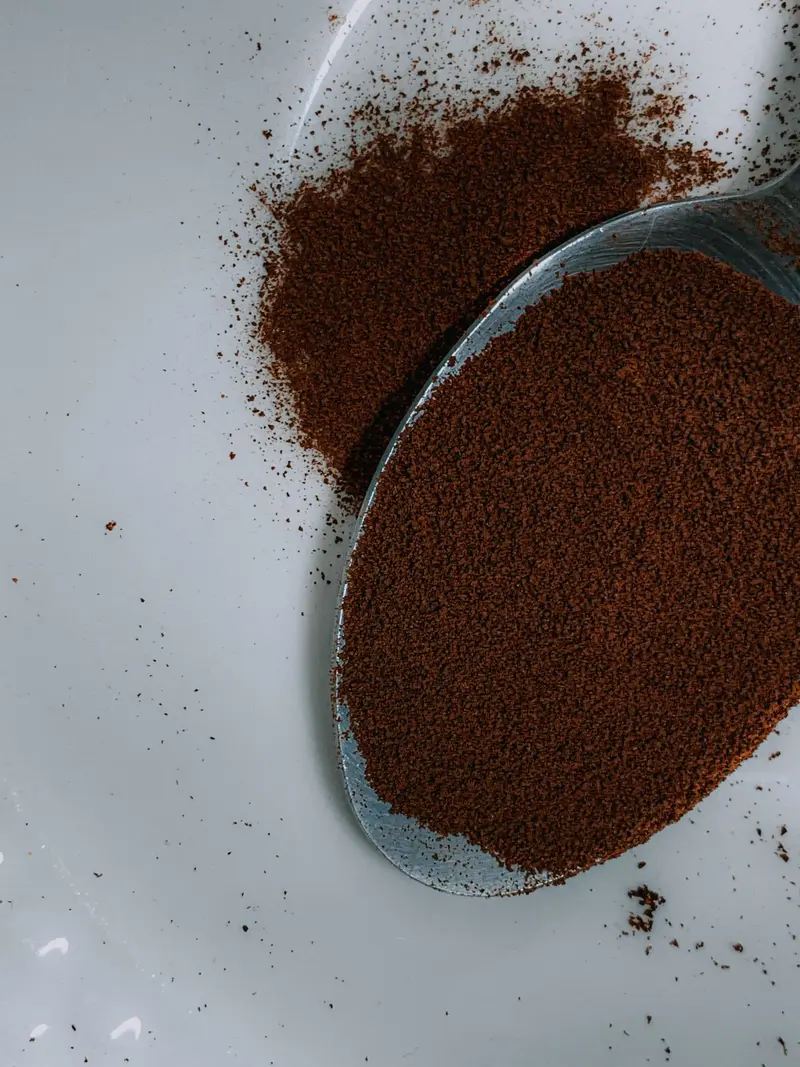
Grind is the one variable you cannot work around. A good pot and careful heat will not rescue coffee that is too coarse, because the method depends on particles small enough to extract in three minutes and then stay partly suspended in the cup. This guide covers how fine is fine enough, how to check it without instruments, and how to get it in a US kitchen.
How fine should Turkish coffee be ground?
Turkish coffee should be ground to a soft powder, like flour or cocoa, with no individual grains you can see or feel. Rub a pinch between thumb and finger. If it feels gritty like fine sand, it is espresso grind and too coarse. If it smears and clings like flour, it is right.
Three quick home checks:
- The pinch test. Turkish grind feels smooth and slightly silky. Any sandiness means it is too coarse.
- The press test. Press a pinch between your fingers and release. Powder that holds a light clump and takes your fingerprint is in the right range.
- The cup test. After brewing and resting two minutes, the grounds should form a smooth, mud-like layer at the bottom. A sandy layer and a thin, watery cup point to a coarse grind.
The fineness has a purpose. As Popular Science reports, a flour-like grind greatly increases the surface area the water can reach, and the finest particles remain in the liquid and give the drink its heavy texture.
What is the Turkish coffee grind size in microns?
Measured figures cluster around 100 microns and below. One industry reference describes Turkish grind as a distribution in which half the particles are under 100 µm. A Turkish food-science paper tested grinds of roughly 47 to 55 µm and 89 to 120 µm. A broader consumer chart gives 40 to 220 µm.
A micron (µm) is a thousandth of a millimeter. For scale, the espresso range on the same consumer chart is 180 to 380 µm, so the two ranges meet only at the edge and Turkish grind sits well below espresso.
| Source | What it says about Turkish grind |
|---|---|
| Barista Hustle cezve course, citing Blittersdorf and Klatt (2016) | Half of all particles are smaller than 100 µm |
| Coşgun and Torun, GIDA (2022), Akdeniz University | Samples classed as very fine (about 47 to 55 µm) and fine (about 89 to 120 µm). The authors cite a standard under which 70 to 75 percent of particles by mass should fall between 75 and 125 µm |
| Honest Coffee Guide grind chart | Approximately 40 to 220 µm, described by the site as an interpretation, not a fixed boundary |
Two cautions about these numbers. First, ground coffee is never one size. Every grinder produces a spread of particles, so a single figure always stands for a distribution. Second, you cannot measure microns at home, and you do not need to. The pinch test above is the traditional way to judge it.
There is also a modern counter-current. Some specialty brewers grind slightly coarser on purpose. The recipe by 2013 World Cezve/Ibrik Champion Turgay Yıldızlı, published by European Coffee Trip, sets the grind between very fine Turkish and espresso to suit lighter roasts. That is a deliberate style choice by people who control every other variable. For a first cup, go fully fine.
Can a regular coffee grinder make Turkish grind?
Usually not. Blade grinders chop unevenly and leave coarse fragments. Many entry-level electric burr grinders stop at espresso or a little finer. Grinders that manage it are traditional Turkish hand mills, some high-precision hand grinders, some espresso-grade electric grinders, and commercial shop grinders with a Turkish setting.
| Grinder type | Reaches Turkish fineness? | What to know |
|---|---|---|
| Traditional brass Turkish hand mill | Yes, it is built for this | Slow, with a small capacity. Burr quality varies a lot between mills, so buy one sold for use, not as a souvenir. |
| Modern steel-burr hand grinder | Some do | Check that the maker lists Turkish or cezve in its range. Expect a long, stiff grind for each cup. |
| Entry-level electric burr grinder | Rarely | Most bottom out around espresso. The manual's grind range will tell you. |
| Espresso-focused electric grinder | Some do | Only if the maker says so. Running an espresso grinder at its finest setting can clog it or let the burrs touch. |
| Blade grinder | No | Long grinding produces dust mixed with grit, and heats the coffee. Sifting helps a little and wastes coffee. |
| Commercial retail or bulk grinder | Often | Many have a marked Turkish setting. This is what a roaster or grocer uses when you ask for Turkish grind. |
| Spice grinder, blender, mortar and pestle | No, with one exception | See the note on dibek coffee below. |
We have not tested grinders and do not rank models. The reliable check is the manufacturer's own documentation: look for "Turkish" or "cezve/ibrik" in the stated grind range, and be skeptical of marketplace listings that claim it without a manual to back it up.
If you have an espresso-capable grinder, do not force it past its finest marked setting to reach Turkish. Burrs that touch can be damaged. Ask the manufacturer instead.
One historical exception to the powder rule deserves a mention. Dibek (dee-BEK) coffee is pounded in a stone mortar with a wooden or iron hammer, and the result is coarser than milled Turkish coffee. A 2023 survey of regional Turkish coffee styles in the Journal of Ethnic Foods describes it as its own category with its own texture. It is a separate tradition, and a home mortar will not reproduce the standard grind.
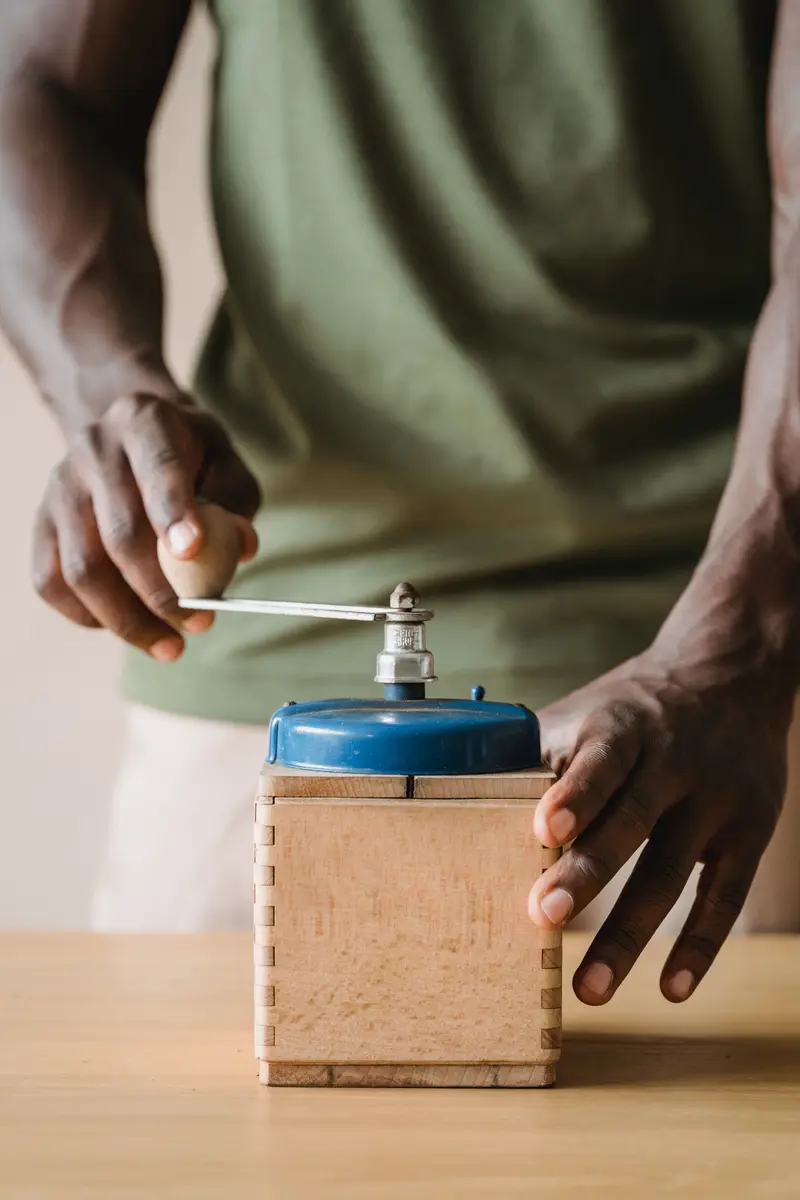
How do you use a Turkish hand mill?
Fill the top chamber with beans, tighten the adjustment screw under the burrs until the powder comes out flour-fine, and turn the handle steadily. A cup's worth, about 7 g, typically takes a few minutes of grinding. The powder collects in the lower chamber.
The classic mill is a tall brass cylinder with a folding crank that stores inside. Three practical points:
- Set the grind with a test. Tighten the screw, grind a few beans, do the pinch test, and adjust. Once set, leave it.
- Grind only what you need. Small chambers are a feature. They make it natural to grind per pot.
- Keep it dry. Brush the burrs out. Do not wash the mill with water, which invites rust on steel burrs and stale residue.
Hand grinding this fine is slow and takes some effort. Many people who love the ritual use the mill on weekends and keep fresh pre-ground coffee for weekdays. That is a reasonable compromise.
Is pre-ground Turkish coffee good enough?
Yes, if it is fresh. Selling coffee already roasted and ground is itself a long tradition in Turkey, and pre-ground coffee from a mill built for the job has a more even powder than most home grinders manage. The trade-off is shelf life, since fine powder goes stale faster than whole beans.
Kurukahveci Mehmet Efendi's company history says its founder began roasting and grinding coffee in his family's Istanbul shop in 1871 and selling it ready to brew, at a time when most people bought green beans and roasted them at home. Buying ground coffee is a long-standing way of doing it, and plenty of careful home brewers do exactly that.
| Pre-ground | Fresh-ground at home | |
|---|---|---|
| Fineness and evenness | Usually excellent | Depends entirely on your grinder |
| Aroma | Best in the first days after opening | Best possible |
| Effort | None | Several minutes per cup by hand |
| Cost to start | Low | A capable grinder is the main expense |
| Main risk | Staleness from slow use or old stock | Grind too coarse |
A third route combines both: buy whole beans from a local roaster and ask them to grind for Turkish coffee on their shop grinder. Ask first whether their grinder has a Turkish setting, since some shop grinders do not go that fine. Buy a small bag and come back often. Our guide to the best coffee for Turkish coffee covers what to buy.
How should you store Turkish coffee?
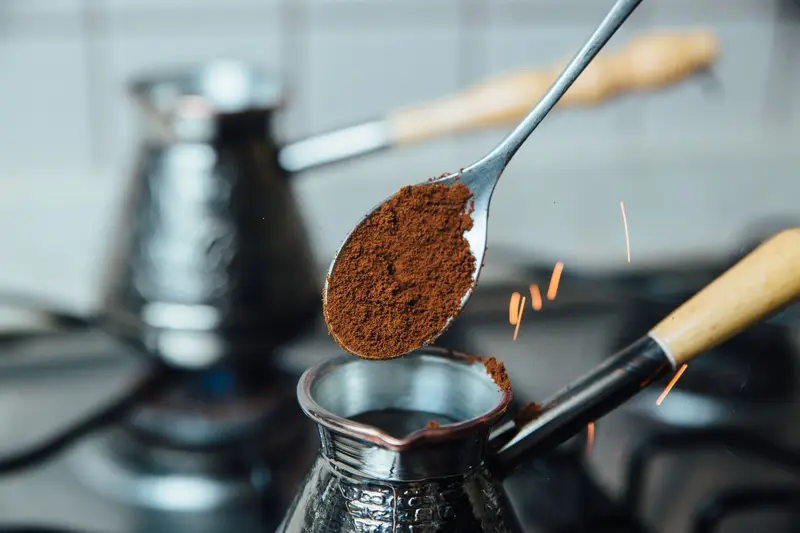
Store it in an airtight, opaque container in a cool, dark, dry cupboard, and buy amounts you will finish within one to two weeks. The four things that stale coffee are air, moisture, heat and light, and a flour-fine powder exposes far more surface to all of them than whole beans do.
The National Coffee Association USA says ground coffee keeps about one to two weeks at room temperature and advises buying freshly roasted coffee in small batches. Its guidance, and Kurukahveci Mehmet Efendi's storage notes, translate into a short routine:
- Seal it. Move coffee from an opened bag into an airtight tin or jar, or fold and clip the bag tightly inside one.
- Keep it dark and cool. Avoid clear jars on the counter and cupboards next to the oven or dishwasher.
- Use a dry spoon. A damp spoon introduces moisture and clumps the powder.
- Finish before refilling. Do not top up a jar that still holds older coffee.
- Skip the fridge door. The association notes that views on refrigerating and freezing differ, because coffee absorbs moisture and odors. If you freeze a sealed surplus, take out about a week's worth at a time and reseal the rest before condensation forms.
Storage also changes what is in the coffee, not only how it smells. The Akdeniz University study cited above tracked ground Turkish coffee for 28 days and measured declines in caffeine and chlorogenic acid over that period, across the storage temperatures and grind sizes it tested. Stale coffee also produces less foam, which is one of the first signs you will notice. See the foam guide.
Where to go next
- Use your grind: how to make Turkish coffee
- How the two finest grinds differ in the cup: Turkish coffee vs espresso
- What grind does to strength: Turkish coffee caffeine
- Taste a properly ground cup first: find a place on the Turkish Coffee Map of America.
Sources
- Coşgun G., Torun M. (2022). The effect of storage temperature on caffeine, chlorogenic acid and fatty acid composition of Turkish coffee. GIDA, The Journal of Food 47(5): 904-915. DOI 10.15237/gida.GD22059
- Barista Hustle: cezve/ibrik lesson on grind size (citing Blittersdorf and Klatt, 2016)
- Honest Coffee Guide: Coffee grind size chart
- Popular Science: How to enjoy the flavor, history, and science of Turkish coffee
- National Coffee Association USA (About Coffee): Storage and shelf life
- Kurukahveci Mehmet Efendi: useful information (storage)
- Kurukahveci Mehmet Efendi: history, Mehmet Efendi
- European Coffee Trip: Make Turkish coffee the specialty way (recipe by Turgay Yıldızlı)
- Journal of Ethnic Foods (2023): Spatial distribution of Türkiye's local Turkish coffee kinds
Questions people ask
Can I use espresso grind for Turkish coffee?
It will brew, but the result is thin, with little foam and a sandy layer of grounds that does not settle cleanly. Espresso grind is clearly coarser than Turkish grind on published charts. Use true Turkish grind for the texture the style is known for.
Why is Turkish coffee ground so fine?
Two reasons. The brew is short, about three minutes, and powder-fine particles extract quickly. The grounds are also served in the cup, where the finest particles stay suspended and create the thick body. Coarser grounds would under-extract and feel gritty.
Is Turkish grind the same as powdered or instant coffee?
No. Turkish coffee is roasted coffee beans milled to powder, and it does not dissolve. The grounds settle at the bottom of the cup. Instant coffee is brewed coffee that has been dried, so it dissolves completely in water. They are different products.
Can I grind Turkish coffee in a blender or spice grinder?
Not well. Blades shatter beans into a mix of dust and larger fragments, and long runs heat the coffee. You may get a drinkable cup, but with weak foam and grit. A burr mill built for Turkish fineness or fresh pre-ground coffee is a better use of good beans.
How long does ground Turkish coffee stay fresh after opening?
Plan on one to two weeks at room temperature in an airtight, opaque container, in line with National Coffee Association USA guidance for ground coffee. It remains safe to drink long after that, but aroma fades and the foam becomes thinner.
Does a finer grind mean more caffeine?
Finer grounds extract more readily, and in this method they also stay in the cup, so little is left behind. How that compares with other brewing styles per serving depends on the dose and cup size. Our Turkish coffee caffeine guide covers the numbers.