Guide
Turkish coffee vs espresso: how they differ
Turkish coffee is powder-fine coffee simmered in a small pot and served unfiltered, grounds included. Espresso is finely ground coffee with hot water forced through it at roughly 9 bar of pressure, typically in under half a minute. Espresso is more concentrated per ounce. A cup of Turkish coffee is larger, so caffeine per serving is similar.
By Ahmet Kırtok · Updated November 26, 2026 · 7 min read

What is the difference between Turkish coffee and espresso?
The difference is how water meets coffee. In Turkish coffee, the grounds sit in the water and heat up with it, and nothing is filtered out. In espresso, a machine pushes hot water through a compressed bed of coffee under high pressure, and a metal filter holds the grounds back.
Everything else follows from that. The table sets the two side by side.
| Turkish coffee | Espresso | |
|---|---|---|
| Method | Immersion: coffee and water heated together in a pot | Pressure: hot water forced through a packed puck of coffee |
| Equipment | Cezve (ibrik) and a heat source | Espresso machine and a capable grinder |
| Grind | Powder, like flour | Fine, like table salt or a little finer |
| Pressure | None beyond normal air pressure | Commonly about 9 bar |
| Brew time | About 2½ to 4 minutes on low heat | Commonly about 25 to 30 seconds |
| Filter | None | Metal basket |
| Typical recipe | 7 g coffee to 70 ml water | Commonly about 7 g for a single; doubles use roughly twice that or more |
| Serving size | 60 to 70 ml (about 2 to 2.4 fl oz) | 25 to 30 ml (about 1 fl oz) per shot |
| Top layer | Dark, dense foam (köpük) | Tan to reddish crema |
| Grounds in the cup | Yes, settled at the bottom | No |
| Sugar | Cooked in the pot, chosen when ordering | Added by the drinker afterward, if at all |
| Caffeine per serving | About 50 to 75 mg in lab studies | About 63 mg per shot (Mayo Clinic) |
| Caffeine per fl oz | About 25 to 43 mg (our arithmetic) | About 58 to 63 mg |
| Body | Heavy, silty, opaque | Syrupy, smooth |
| With milk | Traditionally never | Base for cappuccino, latte and others |
| Skill curve | Easy to start, subtle to master | Steeper, and equipment-dependent |
How does the brewing method differ?
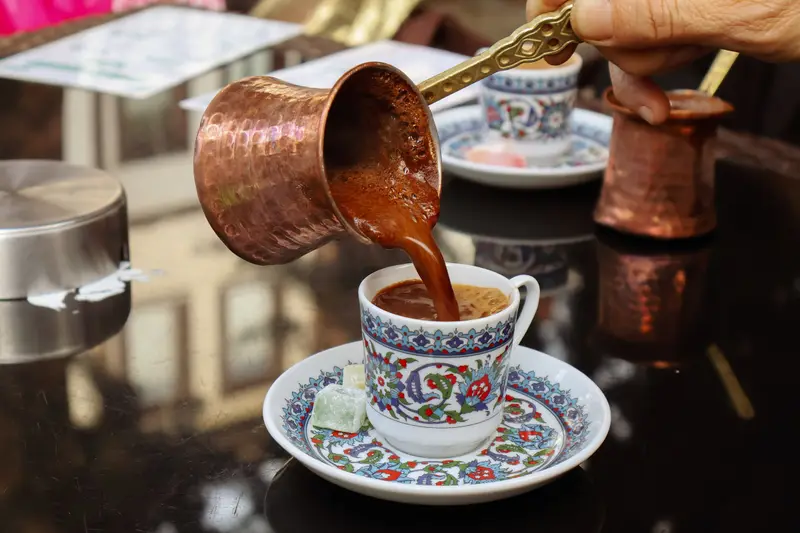
Turkish coffee is brewed by immersion in a cezve (JEZ-veh), the small long-handled pot many English speakers call an ibrik. Cold water, coffee and any sugar are stirred together and warmed slowly until foam rises. Espresso is brewed by percolation under pressure: a pump drives hot water through tamped coffee in seconds.
In the cezve, the brewer controls heat and timing by eye and lifts the pot as the foam climbs, before a rolling boil. Full instructions are in how to make Turkish coffee. In an espresso machine, water just below boiling is forced through at roughly 9 bar, about nine times atmospheric pressure. The figures commonly cited for a traditional Italian shot are about 25 to 30 ml in about 25 to 30 seconds. We give them as typical values, since recipes vary by coffee shop.
Which grind is finer?
Turkish coffee is ground finer than espresso, and finer than anything else in coffee. It should feel like flour or powdered sugar, with no grit between your fingers. Espresso grind is fine but still granular, closer to table salt. The two are not interchangeable.
The reason is mechanical. Espresso needs particles large enough for water to pass through the puck in half a minute. Turkish-grade powder would choke an espresso machine. In the other direction, espresso grind in a cezve sinks too fast, gives thin foam and leaves a gritty cup.
Many espresso grinders cannot reach Turkish fineness. The options are covered in Turkish coffee grind, and bean choice in best coffee for Turkish coffee.
Which is stronger?
Espresso is stronger by concentration. It packs more dissolved coffee and more caffeine into each ounce. Turkish coffee often tastes just as intense because it is unfiltered: fine particles stay suspended in the liquid and give it a heavier, thicker feel than its concentration alone would suggest.
"Strong" can mean three things, and the answer changes with each:
- Concentration. Espresso wins. About 7 g of coffee to 25 or 30 ml of water is far tighter than 7 g to 70 ml.
- Body. Turkish coffee wins. Nothing is filtered out, so the cup is opaque and heavy.
- Caffeine per serving. Roughly a tie. See the next section.
Which has more caffeine?
Per serving they are close. A single shot of espresso has about 63 mg of caffeine according to Mayo Clinic. Lab measurements of Turkish coffee put a small cup at roughly 50 to 75 mg. Per fluid ounce, espresso has around twice as much.
One study measured both drinks in the same lab. Researchers in Jordan found about 49 mg in a 25 ml café espresso and about 51 mg in a 50 ml coffee shop Turkish coffee. The servings carried nearly the same caffeine, and the espresso delivered it in half the volume.
A double espresso, which is the default in many American coffee shops, has about twice the caffeine of a single and clearly more than one Turkish coffee. Ranges, sources and the reasons numbers vary are laid out in how much caffeine is in Turkish coffee.
One more difference concerns filtering. Coffee oils contain cafestol and kahweol, compounds linked to higher LDL cholesterol. A 1997 analysis found about 5 mg of each in a cup of Turkish-style coffee and about 1 mg of each in an espresso. The caffeine guide explains the research. For personal health questions, ask your clinician.
Is the foam on Turkish coffee the same as crema?
No. Crema is created by pressure. The usual explanation is that hot water under pressure dissolves carbon dioxide from the coffee and emulsifies its oils, which emerge as a tan, fine-bubbled layer. Turkish coffee foam forms without pressure, as gas and very fine particles rise while the pot slowly heats.
Turkish foam, called köpük (kuh-PEWK), is darker and denser, and it carries fine coffee particles. It also means more to the person being served. Traditionally, a cup without foam is taken as a sign of a careless host. UNESCO's description of the tradition singles out slow heating to produce the desired foam.
Technique for the pot is in Turkish coffee foam.
How does equipment cost compare?
Turkish coffee is one of the least expensive ways to make excellent coffee at home, and espresso is one of the most expensive. A cezve is a simple pot with no moving parts, and it works on any stove. Espresso needs a machine that holds stable temperature and pressure, a grinder precise enough to match it, counter space and regular maintenance.
We have not listed dollar figures because prices change and we publish only numbers we have checked. As a rule, a cezve is priced like a small piece of cookware, while a home espresso setup is a serious appliance purchase.
Buying advice for the pot, including size and material, is in the cezve and ibrik guide. If you want to try the method before buying anything, see Turkish coffee without a cezve.
How do they taste different?
Espresso tastes concentrated and syrupy, with pronounced acidity or bitterness depending on the roast, and it finishes clean. Turkish coffee tastes rounder and heavier, with a velvety, slightly powdery texture and a long finish. If sugar was added, the sweetness is cooked in.
Espresso is over in two or three sips. Turkish coffee is meant to last a conversation: you wait for it to settle, sip slowly, and stop above the grounds. Espresso is the base for milk drinks. Turkish coffee is drunk black, with a glass of water alongside.
Which one should you choose?
Choose Turkish coffee if you want a slow, full-bodied cup with almost no equipment, and you enjoy the ritual of making and sharing it. Choose espresso if you want speed, milk drinks and precise repeatability, and you accept the cost and upkeep of a machine.
If you have never had a well-made Turkish coffee, order one before deciding. Our map lists verified places across the United States that brew it to order, and what is Turkish coffee explains what to expect when it arrives.
Sources
- Mayo Clinic: Caffeine content for coffee, tea, soda and more
- Hammad S, Tayyem R, Musaiger AO (2015). Caffeine content in beverages commonly consumed in Jordan. Pakistan Journal of Nutrition.
- Hancı M et al. (2013). Caffeine levels in Turkish coffee and some beverages sold in Turkey. Düzce Tıp Dergisi 15(3):34-38.
- Gross G, Jaccaud E, Huggett AC (1997). Analysis of the content of the diterpenes cafestol and kahweol in coffee brews. Food and Chemical Toxicology 35(6):547-554.
- UNESCO Intangible Cultural Heritage: Turkish coffee culture and tradition (element 00645)
Questions people ask
Can I make Turkish coffee with espresso grounds?
You can, but the result is poor. Espresso grind is too coarse for the cezve, so it sinks quickly, produces little foam and tastes thin and gritty. For a proper cup, use coffee ground to a powder specifically for Turkish coffee.
Can I use Turkish coffee in an espresso machine?
No. Powder-fine coffee packs so tightly that water cannot pass through at normal pressure. The machine will choke, drip slowly or produce a harsh, over-extracted shot. Use Turkish grind only for the pot.
Which is healthier, Turkish coffee or espresso?
Neither is simply healthier. They have similar caffeine per serving. Turkish coffee is unfiltered and contains more of the coffee oils linked to higher LDL cholesterol than espresso does. How much that matters depends on how much you drink and on your own health, so ask your clinician.
Which is older, Turkish coffee or espresso?
Turkish coffee, by several centuries. Coffee was being brewed in pots in Ottoman cities in the 16th century. Espresso machines appeared in Italy around the start of the 20th century.