Guide
How to make Turkish coffee
To make Turkish coffee, stir 7 g of flour-fine coffee and any sugar into 70 ml of cold water per cup in a cezve. Heat it slowly for about three minutes without stirring again, spoon the first foam into the cup, let the pot rise once more, pour, and rest for a minute.
By Ahmet Kırtok · Updated November 26, 2026 · 9 min read
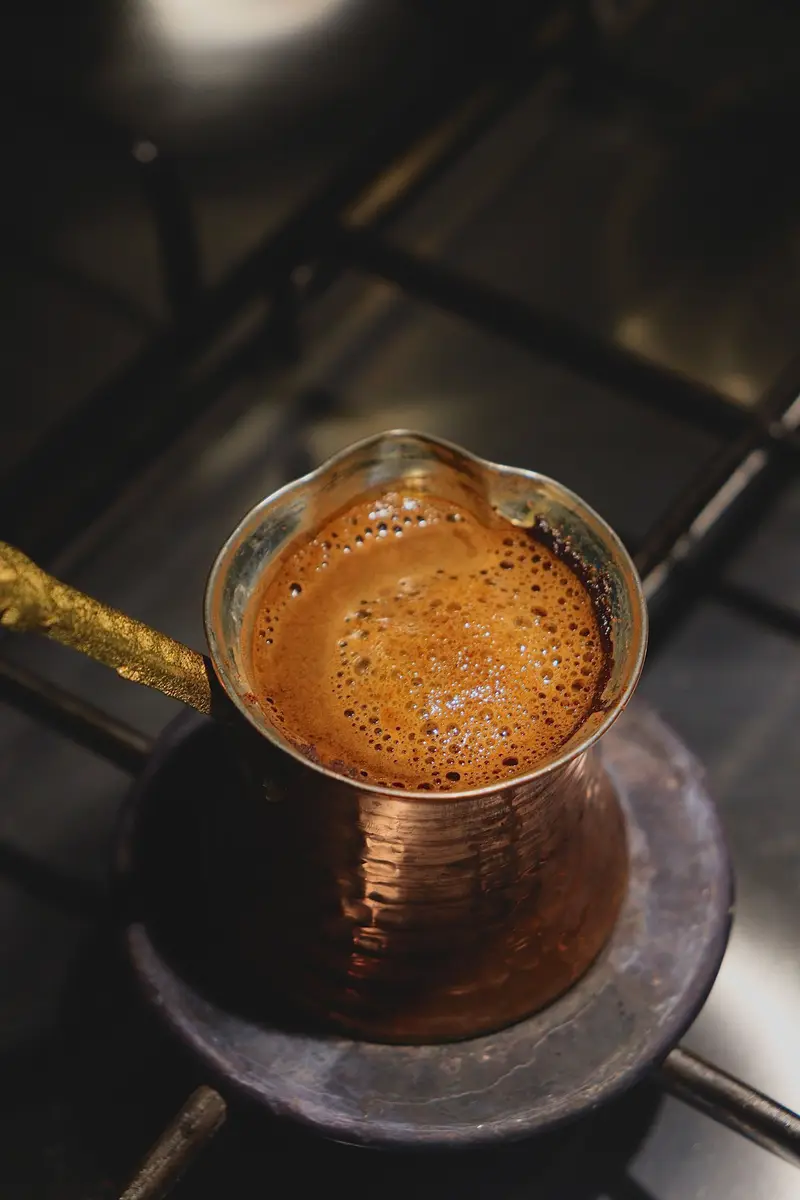
That is the whole method. The rest of this guide gives the measurements, the timing, the reasons behind each step and the fixes for what usually goes wrong. The pot is a cezve (JEZ-veh), which many English speakers call an ibrik. The foam is köpük (kuh-PEWK), and the grounds that settle in the cup are telve (TEL-veh).
What do you need to make Turkish coffee?
You need four things: coffee ground as fine as flour, cold drinking water, a small narrow-necked pot, and a low, steady heat source. A kitchen scale helps the first few times. Sugar is optional, but it has to go in before brewing, so decide on it first.
| Item | What to use | Notes |
|---|---|---|
| Coffee | 7 g per cup, Turkish grind | It should feel like flour, with no grit. See the grind guide. |
| Water | 70 ml (about 2.4 fl oz) per cup, cold | Measure it with the cup you will serve in. |
| Pot | A cezve sized to the number of cups | The liquid should reach the base of the neck. See the cezve guide. |
| Cup | A fincan (fin-JAHN), roughly 60 to 70 ml | An espresso cup works. |
| Heat | The smallest burner on low | Gas, electric, or hot sand. |
| Sugar | White sugar or cubes, optional | Added to the cold water, never to the finished cup. |
The traditional way to measure water is with the cup itself, which is how Kurukahveci Mehmet Efendi, the Istanbul roaster in business since 1871, words its own instructions. Recommendations differ a little. Some roasters recommend about 6 g: that page gives one teaspoon, about 6 g, per cup. Specialty brewers lean a little stronger: the recipe by 2013 World Cezve/Ibrik Champion Turgay Yıldızlı published by European Coffee Trip uses 7 g to 70 g of water. Our 7 g to 70 ml sits inside that range and is easy to scale.
Seven grams is about one well-heaped teaspoon, or two level ones. Spoons and grinds vary, so weigh it once and see what your own spoon holds.
What is the exact Turkish coffee recipe for one cup?
For one cup, use 7 g of coffee and 70 ml of cold water, a 1:10 ratio, in a cezve small enough that the liquid reaches the neck. Brew on low heat for roughly two and a half to four minutes. Add sugar at the start if you want it.
- Measure the water. Fill your serving cup with cold drinking water and pour it into the cezve. For one standard cup that is about 70 ml.
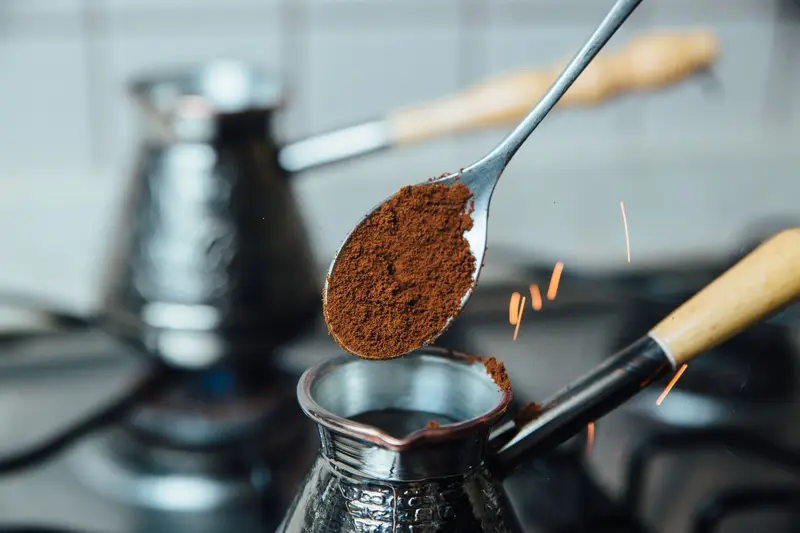
- Add coffee and sugar. Add 7 g of coffee and the sugar for your chosen level (see the next section).
- Stir once, thoroughly. Stir for 10 to 15 seconds until no dry clumps remain and the sugar has started to dissolve. This is the only time you stir.
- Heat slowly. Put the cezve on the smallest burner at low to medium-low. Do not cover it and do not walk away.
- Watch for the foam ring. After a couple of minutes a dark ring forms at the edge and creeps toward the center. The surface will dome and begin to climb the neck.
- Take the first foam. As the foam rises, lift the cezve off the heat. Spoon a little foam into the cup.
- Let it rise once more. Return the pot to the heat for a few seconds until the coffee climbs again, then remove it before it breaks into a rolling boil.
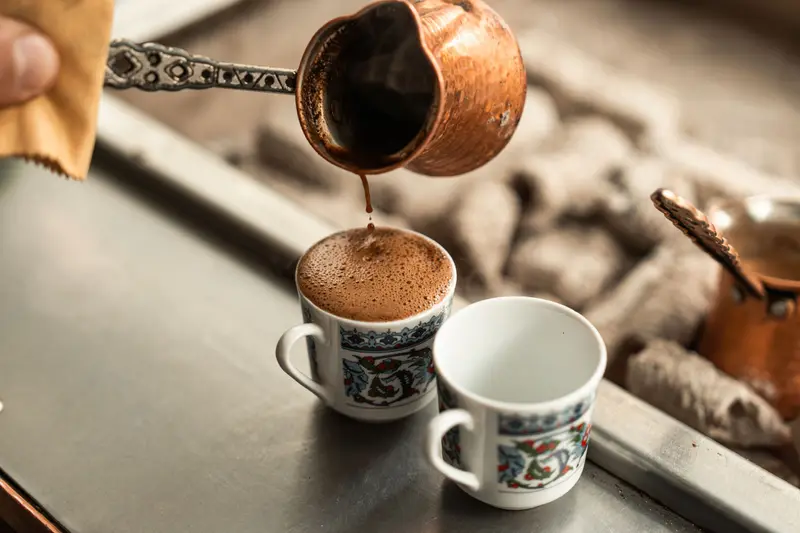
- Pour. Pour slowly down the side of the cup so the foam you spooned in floats up rather than breaking.
- Rest. Wait one to two minutes so the grounds settle. Serve with a glass of water.
Steps 6 and 7 follow the traditional two-rise method that Mehmet Efendi describes. Many specialty brewers skip the second rise, take the pot off the moment the foam nears the rim and pour everything in one go. Both are legitimate. Some brewers find the single rise a little lighter and the double rise fuller-bodied. Try both with the same coffee and keep the one you prefer.
When and how much sugar do you add?
Sugar is added to the cold water with the coffee and cooked in, because stirring a finished cup would lift the grounds. There are four standard levels: sade (no sugar), az şekerli (a little), orta (medium) and şekerli (sweet). Ask each guest before you start.
| Level | Say it | Sugar per cup | In grams |
|---|---|---|---|
| Sade | sah-DEH | None | 0 g |
| Az şekerli | AHZ sheh-ker-LEE | 1 sugar cube | 2 to 3 g |
| Orta | or-TAH | 1½ sugar cubes | 3 to 4.5 g |
| Şekerli | sheh-ker-LEE | 2 sugar cubes | 4 to 6 g |
These amounts follow the guidance on GoTürkiye, the national tourism portal, which labels the levels in English as plain, a little sweet, medium sweet and very sweet. The Turkish names are the ones commonly used for those levels. Households differ, and many people simply count half a teaspoon, one teaspoon and two teaspoons. Because the sugar is cooked in, guests who want different levels need separate pots, a point the Daily Sabah makes as well. Brew the unsweetened pot first if you only have one cezve.
How hot and how long should Turkish coffee brew?
Start with cold water and aim for a brew of about two and a half to four minutes for one cup. Foam builds as the coffee passes roughly 80 to 90 °C (176 to 194 °F). Take the pot off before a rolling boil, which sits at 100 °C (212 °F) at sea level.
Published numbers differ slightly, and they agree on the shape of the curve. GoTürkiye puts the first rise near 80 °C and the second near 90 °C, with about three minutes on low heat. Barista Hustle's cezve course says foam begins around 88 °C and recommends pouring before 93 °C. Yıldızlı's competition-style recipe runs two to two and a half minutes because it starts with 60 °C water.
Cold water and low heat matter for a practical reason: they give the coffee time to extract before the foam arrives. If your one-cup pot foams in under 90 seconds, the heat is too high. If nothing has happened after five minutes, raise it slightly. You do not need a thermometer. The rising foam is your signal.
One wording issue causes confusion. Traditional instructions, including Mehmet Efendi's, speak of bringing the coffee to a boil. In practice that means the foamy rise, which happens just under a true boil. A hard, bubbling boil breaks the foam and makes the cup harsher.
How do you scale the recipe for two, three or four cups?
Keep the 1:10 ratio and multiply: 7 g of coffee and 70 ml of water for each cup. Use a larger cezve so the liquid still reaches the base of the neck, lower the heat a notch, and expect a longer brew. Share the foam between cups before pouring.
| Cups | Cold water | Coffee | Sugar for orta | Cezve size (to the brim) | Approximate time on low heat |
|---|---|---|---|---|---|
| 1 | 70 ml (2.4 fl oz) | 7 g | 1½ cubes | about 100 to 120 ml | 2½ to 4 min |
| 2 | 140 ml (4.7 fl oz) | 14 g | 3 cubes | about 200 to 230 ml | 4 to 5 min |
| 3 | 210 ml (7.1 fl oz) | 21 g | 4½ cubes | about 300 to 340 ml | 5 to 6 min |
| 4 | 280 ml (9.5 fl oz) | 28 g | 6 cubes | about 400 to 450 ml | 6 to 7 min |
The cezve sizes and times are our working guide, not a standard. Times depend heavily on your burner and the pot's metal. For more than four cups, brew two pots. A very large batch is hard to pour evenly, and the last cup tends to get most of the grounds.
When pouring several cups, spoon foam into every cup first, then fill each cup halfway, then top them all up in a second pass. That evens out both the foam and the strength.
What are the most common Turkish coffee mistakes?
Most failed cups trace back to five things: a grind that is too coarse, heat that is too high, stirring after the first minute, letting the pot boil hard, or a cezve that is too big for the amount. Each one has a simple fix.
| What happened | Likely cause | Fix |
|---|---|---|
| Gritty, thin cup | Grind too coarse (espresso grind or coarser) | Buy or grind to true Turkish fineness. See the grind guide. |
| No foam | Stale coffee, pot too wide, or stirred during heating | Use fresher coffee, a smaller cezve, and stir only at the start. See the foam guide. |
| Boiled over | Heat too high or attention elsewhere | Use the smallest burner on low and stay with the pot. |
| Bitter, harsh taste | Hard boil, very dark roast, or brewed too long | Remove at the rise, try a medium roast. |
| Weak and watery | Too much water, or a cup larger than 70 ml | Measure water with the serving cup, weigh the coffee. |
| Mouthful of grounds | Drank too soon or stirred the cup | Rest one to two minutes and leave the last sip. |
| Sugar not sweet enough | Added after brewing | Sugar goes into the cold water before heating. |
If you do not own a cezve yet, a very small saucepan will get you started. Our guide to Turkish coffee without a cezve explains what changes.
How do you pour, rest and drink it?
Pour slowly along the side of the cup, wait one to two minutes for the grounds to settle, and sip without stirring. Stop when you reach the thick layer at the bottom. A glass of water alongside is traditional, and many people drink some before the coffee.
UNESCO's description of Turkish coffee culture and tradition, inscribed in 2013, mentions the small cup and the glass of water as part of the practice. Our guide on how to serve Turkish coffee covers cups, sweets and the order of serving guests.
Brew only what you will drink now. Turkish coffee does not reheat well, and the foam will not come back.
Where to go next
- Choosing a pot: cezve and ibrik guide
- Choosing beans: best coffee for Turkish coffee
- The slow, traditional heat source: Turkish sand coffee
- Background: what is Turkish coffee? and Turkish vs Greek vs Arabic coffee
- How strong it is: Turkish coffee caffeine
- Terms: Turkish coffee glossary
- To taste one made by someone else first, find a place on the Turkish Coffee Map of America.
Sources
- Kurukahveci Mehmet Efendi: brew guide, Turkish coffee with cezve
- Kurukahveci Mehmet Efendi: Turkish coffee, definition and history
- Kurukahveci Mehmet Efendi: useful information
- UNESCO Intangible Cultural Heritage: Turkish coffee culture and tradition
- GoTürkiye (Türkiye Tourism Promotion and Development Agency): Turkish coffee
- Barista Hustle: cezve/ibrik lesson on foam (raghweh)
- European Coffee Trip: Make Turkish coffee the specialty way (recipe by Turgay Yıldızlı)
- Fresh Cup Magazine: Brewing Turkish coffee
- Popular Science: How to enjoy the flavor, history, and science of Turkish coffee
- Daily Sabah: Turkish coffee, crown of Türkiye, best mate of Turkish delight
Questions people ask
Do you start Turkish coffee with cold or hot water?
Cold or room-temperature water is the traditional start, and UNESCO's description of the practice specifies cold water. It gives the grounds a few minutes to extract before the foam rises. Some specialty recipes begin with water at about 60 °C (140 °F) to shorten the brew to around two minutes.
Can I add milk to Turkish coffee?
The classic drink is made with water only. Some people do brew it with milk in place of water, which gives a sweeter, softer cup, but the milk scorches easily and foams differently. If you try it, use very low heat and a slightly larger pot.
Should I stir Turkish coffee while it heats?
Stir once at the start, until the coffee is fully wet and the sugar begins to dissolve, then leave it alone. Stirring during heating breaks the foam as it forms. Stirring in the cup lifts the settled grounds back into the liquid.
Do I need to filter Turkish coffee?
No. The grounds are part of the drink and settle to the bottom of the cup on their own within a minute or two. Filtering removes the body that defines the style. Simply stop drinking when you reach the thick layer.
How many teaspoons of coffee per cup?
One well-heaped teaspoon, or two level teaspoons, comes to roughly 7 g of Turkish-ground coffee, which suits a 70 ml cup. Spoon sizes and grind density vary, so weigh your first few brews and note what your own spoon delivers.
Can I make Turkish coffee on an electric or induction stove?
Yes on electric coil and glass-top stoves, using the smallest element on low. Induction works only with a magnetic pot, so a plain copper or brass cezve will not heat. Use a stainless steel cezve made for induction or an induction adapter plate. See the cezve guide.