Guide
The history of Turkish coffee: from Yemen to Istanbul to America
Coffee drinking began among Sufi communities in Yemen in the 15th century and reached Istanbul in the first half of the 16th. Ottoman sources date the city's first coffeehouse to about 1555. From there the drink and the coffeehouse spread to Europe in the 1600s. UNESCO inscribed Turkish coffee culture and tradition on December 5, 2013.
By Ahmet Kırtok · Updated November 26, 2026 · 11 min read
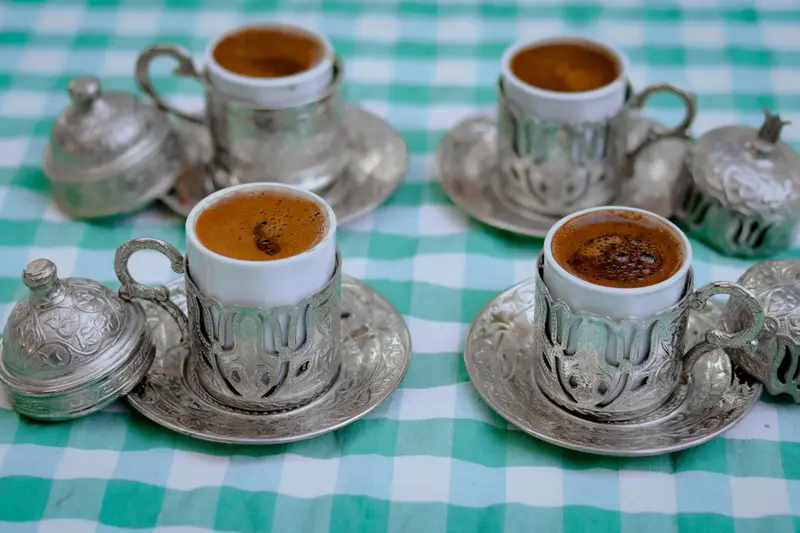
Timeline of Turkish coffee at a glance
The short version: the coffee plant comes from Ethiopia, the drink took shape in Yemen, the coffeehouse matured in Ottoman cities, and Europe learned both from the Ottomans. The table gives the dates we could source, with legends marked.
| Date | What happened | Status |
|---|---|---|
| Undated | A goatherd named Kaldi notices his goats dancing after eating coffee cherries | Legend |
| 15th century | Sufis in Yemen drink coffee to stay awake during night devotions | Documented by historians |
| 1511 | An official in Mecca tries to ban coffee; he is soon overruled | Documented, details disputed |
| 1517 | Ottomans take Egypt; Turkish sources place coffee's arrival in Istanbul after this | Reported |
| 1543 | A fatwa against coffee is reported in Istanbul | Reported |
| About 1555 | First coffeehouse opens in Istanbul's Tahtakale district | Reported by Ottoman sources |
| 1582 | Coffee sellers parade with the guilds before Sultan Murad III | Shown in the festival's illustrated record |
| 1633 | Murad IV closes Istanbul's coffeehouses | Documented |
| Early 1650s | Coffeehouses open in Oxford and London | Documented; exact Oxford year is traditional |
| 1670 | Dorothy Jones is licensed to sell coffee in Boston | Documented |
| 1683 | Vienna's coffeehouse story begins after the Ottoman siege | Part legend |
| 1876 | A Turkish café stands at the Centennial Exhibition in Philadelphia | Documented |
| December 5, 2013 | UNESCO inscribes Turkish coffee culture and tradition | Documented |
Where did coffee drinking begin?
Coffee as a hot drink began in Yemen. The plant is native to the Ethiopian highlands, but historians place the first brewed coffee in Yemen in the 14th or 15th century. The earliest firm evidence points to Sufi communities there, who drank it to stay awake through night-long devotions.
The best-known origin story is about an Ethiopian goatherd named Kaldi, whose goats became lively after eating red coffee cherries. It is a legend. No early source confirms it, and it should be enjoyed as a story.
The documented beginning is quieter. According to historian Ralph Hattox, whose 1985 book Coffee and Coffeehouses remains the standard study, Sufi orders in 15th-century Yemen used the drink, called qahwa in Arabic, during their zikr ceremonies. By the same century, according to the Folger Shakespeare Library's account, a Red Sea trade had formed around the Yemeni port of Mocha, supplied from the Ethiopian highlands.
From Yemen coffee moved north with pilgrims, students and merchants to Mecca and Cairo. It met resistance almost at once. In Mecca in 1511, an official named Kha'ir Beg ordered coffee sales stopped after finding men drinking it near a mosque. A higher authority reversed him within weeks, telling him to police disorderly gatherings and leave the drink alone. Historians note that the details of the episode are disputed, but the pattern it set would repeat for two centuries: rulers worried less about coffee than about the conversations it encouraged.
When did coffee reach Istanbul?
Coffee reached Istanbul in the first half of the 16th century. Turkish sources place its arrival after 1517, when Sultan Selim I took Egypt and brought the coffee-drinking lands of the Red Sea into the empire. By the 1540s it was familiar enough in the capital to draw a religious ruling against it.
A popular account credits Özdemir Pasha, an Ottoman governor of Yemen, with bringing coffee beans to the palace and introducing the drink to Sultan Süleyman the Magnificent, who reigned from 1520 to 1566. Writers repeat it often. Historians treat it as uncertain, and we suggest reading it as tradition.
Turkish accounts also describe a reaction. The jurist Ebussuud Efendi is reported to have issued a fatwa against coffee in 1543, and sacks of beans that had arrived by ship were said to have been thrown into the sea. Coffee drinking continued all the same. Later in the century the chief jurist Bostanzade Mehmed Efendi wrote a ruling in verse declaring the suspicions groundless.
When did the first coffeehouses open in Istanbul?
Ottoman sources date Istanbul's first coffeehouse to about 1555, and accounts that follow the chronicler Peçevi place it in the Tahtakale market district during the reign of Süleyman the Magnificent. Tradition says two men from Syria opened it. Coffeehouses then spread across the city and the empire.
Tradition, following the 17th-century chronicler İbrahim Peçevi, names the founders as Hakem of Aleppo and Şems of Damascus, and some writers give the year as 1554. A competing claim that a coffeehouse called Kiva Han opened in the city in 1475 appears in many popular histories. Historian Niki Gamm reports it as a claim, and the Ottoman sources she cites give 1555.
Peçevi described what the new institution looked like: groups of twenty or thirty men gathered to read, play backgammon and chess, and talk about poetry and literature. The coffeehouse offered something the city had not had before, a public room that was neither mosque, market nor home. The Ministry of Culture and Tourism of Türkiye notes that after coffee's introduction, coffeehouses opened even in the smallest settlements.
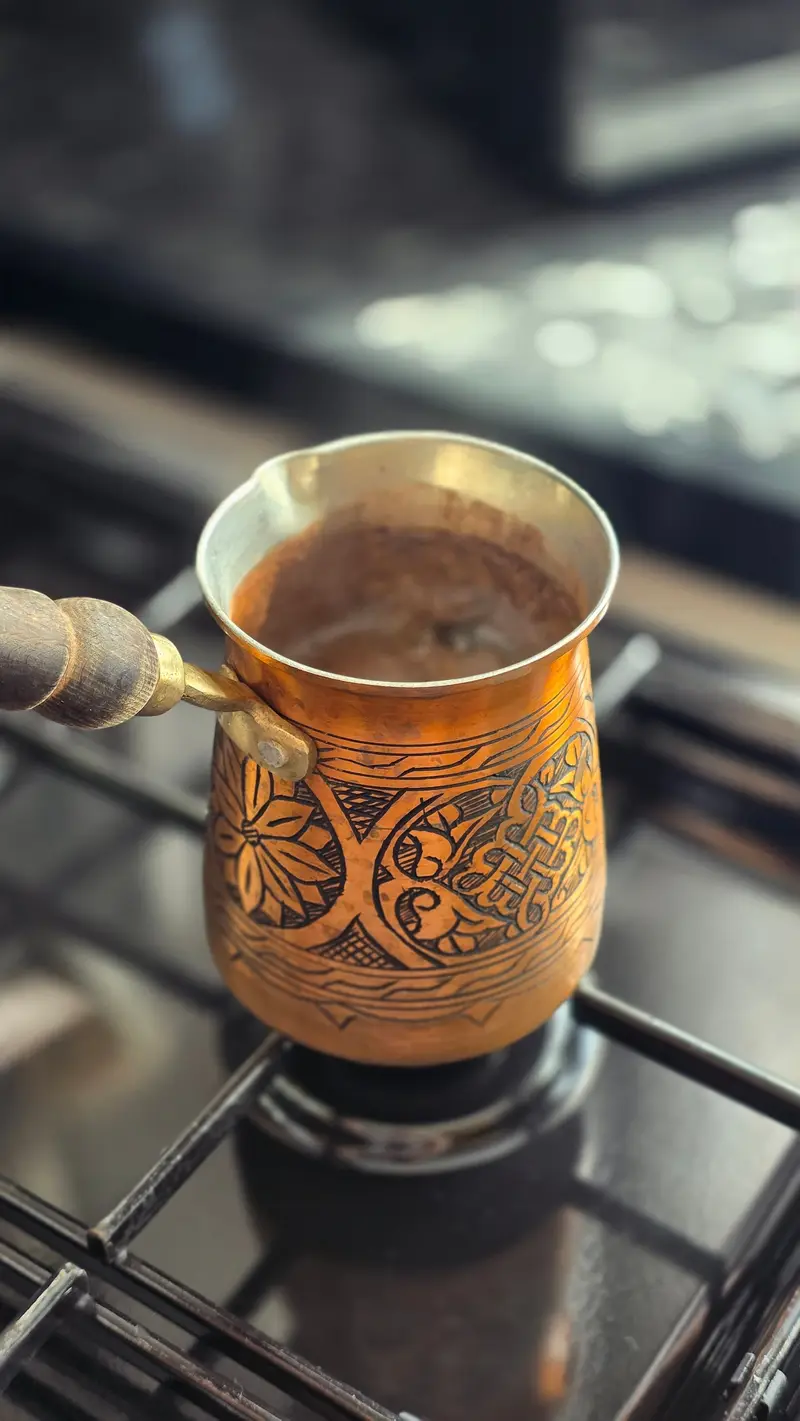
This is also where the method we now call Turkish coffee took its settled form: beans roasted, pounded or milled to a powder, and simmered in a small pot. The pot's Turkish name, cezve (JEZ-veh), entered a dozen languages. Our cezve and ibrik guide follows the vessel itself.
How did coffee become part of Ottoman court and city life?
By the late 16th century coffee was established at court and in the streets. The palace employed a chief coffee maker, and coffee sellers took part in the guild processions before Sultan Murad III at the imperial festival of 1582, a scene painted in the festival's illustrated record, the Surname-i Hümayun.
At the palace, a chief coffee maker was responsible for the sultan's coffee and its utensils. Fine cups, trays, and vessels in silver and other precious materials became part of how a household showed respect to guests. In ordinary homes the same idea took a simpler shape, and it survives today: Türkiye's culture ministry notes that special guests are served in finer cups than the everyday ones.
Many customs that still surround the cup grew in this setting. Coffee is served at engagements and holidays. In the custom of asking for a bride's hand, the bride-to-be traditionally prepares the coffee, and a playful version of the custom has her salting the groom's cup. Grounds left in the cup are read as a fortune, which we cover in Turkish coffee fortune telling. A proverb says a single cup of coffee is remembered for forty years.
Why were coffeehouses banned?
Coffeehouses were banned because rulers feared gatherings they could not control. Religious objections supplied the language, but the closures tracked political unrest. The most famous came in 1633, when Sultan Murad IV shut Istanbul's coffeehouses and made public coffee drinking a capital offense.
Murad IV's crackdown also covered tobacco, opium and taverns, and historians say it was aimed at the capital, where soldiers' revolts threatened him most. He did not outlaw coffee itself.
Later closures followed under other rulers, and the coffeehouses reopened each time. Historians interviewed by Atlas Obscura argue that these crackdowns were aimed at dissent more than at coffee, and that they eased when a ruler felt secure. By the late 18th century the bans had stopped.
How did Turkish coffee spread to Europe?
Europeans met coffee in Ottoman cities and carried the habit home in the 17th century. Travelers described it first, merchants imported it next, and coffeehouses followed. The coffee they first learned to make was prepared the Ottoman way: ground, boiled in a pot and served unfiltered.
English travelers wrote about it early. In 1599 Sir Anthony Sherley recorded people drinking coffee in Ottoman Aleppo. England's first coffeehouses opened in Oxford and London in the early 1650s, and Oxford is traditionally given the earlier date of 1650. London's is better documented: in about 1652 Pasqua Rosée opened a coffeehouse in St Michael's Alley, Cornhill, backed by his employer Daniel Edwards, a Levant Company merchant. Both men knew coffee from the Ottoman port of Smyrna (today's İzmir).
The Ottoman link was obvious to Londoners: historian Brian Cowan counted 37 London coffeehouses named "Turk's Head."
Vienna's story mixes fact and legend. The legend says that after the Ottoman siege of 1683, Georg Franz Kolschitzky was rewarded with sacks of coffee beans the army left behind and opened the city's first coffeehouse. The City of Vienna presents this as legend and credits an Armenian, Johannes Diodato, with the first coffeehouse. The city's own page dates it to 1683, and some histories give 1685.
In the 18th century European powers grew coffee in their colonies in Asia and the Caribbean, and the trade shifted away from Yemen. Brewing changed too. Filtered and later pressure-brewed coffee became the norm in the West, while the pot method remained a daily cup from the Balkans to the Arab world.
Why is the same coffee called Greek, Armenian, Bosnian or Arabic?
The method spread across the Ottoman Empire, and each community that adopted it kept it after the empire ended. The coffee is the same in its essentials. The names reflect language, identity and, sometimes, politics.
In Greece, the drink was still generally called "Turkish coffee" in the 1960s. According to NPR's reporting from Athens, the name "Greek coffee" spread after the events in Cyprus in 1974, and Greek coffee brands promoted it in advertising in the early 1990s. In Bosnia and Herzegovina it is Bosnian coffee, prepared with its own technique. In Armenia it is Armenian coffee or simply black coffee.
UNESCO's lists reflect this plurality. Alongside Türkiye's 2013 inscription, "Arabic coffee, a symbol of generosity" was inscribed in 2015 for the United Arab Emirates, Saudi Arabia, Oman and Qatar, and extended in 2024 to include Jordan. We describe each tradition on its own terms in Turkish vs Greek vs Arabic coffee.
What did UNESCO recognize in 2013?
On December 5, 2013, UNESCO's Intergovernmental Committee, meeting in Baku, Azerbaijan, inscribed "Turkish coffee culture and tradition" on the Representative List of the Intangible Cultural Heritage of Humanity. The element was nominated by Türkiye and adopted as decision 8.COM 8.28.
The wording is "culture and tradition." The listing covers the preparation (fresh roasting, fine grinding, slow heating in the pot for foam, service in small cups with water) together with the social life around it: coffeehouse conversation, hospitality, engagements and holidays, and fortune reading from the grounds. The committee noted that the knowledge is passed on informally within families, and that the tradition had been on Türkiye's national inventory since 2010.
The anniversary is now observed as World Turkish Coffee Day. In 2025, Turkish media reported a further recognition: registration of Turkish coffee in the European Union as a Traditional Speciality Guaranteed product.
When did Turkish coffee arrive in the United States?
Coffee was sold in colonial Boston by 1670, and Americans could see a Turkish café at the 1876 Centennial Exhibition in Philadelphia. The cezve itself arrived in family kitchens with immigrants from the Ottoman lands and their successor states, and it has stayed in those communities ever since.
The first date is from Massachusetts records: in 1670 Dorothy Jones of Boston received the colony's first license to sell coffee and chocolate. Paper filters and espresso machines were far in the future, so coffee in this period was typically boiled in a pot, as Europe had learned from the Ottomans.
The second is a picture. The Historical Society of Pennsylvania holds an October 1876 watercolor titled "Turkish Café and Bazaar at the Centennial Exhibition," showing a small, multicolored building topped with a star and crescent in Fairmount Park. The record does not say what was served, so we will not guess.
The lasting arrival was domestic and mostly undocumented. Greek, Armenian, Syrian, Lebanese, Turkish, Bosnian and later Yemeni families brought their pots and their habits, and their bakeries, restaurants and social clubs served the coffee they knew. Those places, and newer ones opened by a younger generation, are what our Turkish Coffee Map of America sets out to document, one verified listing at a time.
To taste the history, make a cup the traditional way. If the vocabulary is new, the glossary will help, and what is Turkish coffee covers the basics.
Sources
- UNESCO Intangible Cultural Heritage: Turkish coffee culture and tradition (element 00645)
- UNESCO: Decision of the Intergovernmental Committee 8.COM 8.28
- UNESCO news, 5 December 2013: Eleven new inscriptions on the Representative List
- UNESCO: Decision 10.COM 10.B.32, Arabic coffee, a symbol of generosity (2015)
- UNESCO: Decision 19.COM 7.B.55, Arabic coffee, a symbol of generosity, extended inscription (2024)
- Farshid Emami, Coffee and Coffeehouses in Ottoman and Safavid Lands, 1500-1800, Khamseen: Islamic Art History Online, University of Michigan (2021)
- Neha Vermani, The Islamic history of coffee, Folger Shakespeare Library (May 14, 2021)
- Niki Gamm, Coffee and coffeehouses among the Ottomans, Hürriyet Daily News (December 26, 2014)
- Atlas Obscura: In Istanbul, drinking coffee in public was once punishable by death (interviews with historians Ralph Hattox, Madeline Zilfi, Baki Tezcan, Markman Ellis)
- Ekrem Buğra Ekinci, Transformation of Ottoman coffeehouses to the present, Daily Sabah (October 9, 2015): 1554, Tahtakale, founders per Peçevi
- Kurukahveci Mehmet Efendi: Turkish coffee, definition and history (1554, Tahtakale)
- The Courtauld, Illuminating Objects: Pasqua Rosée, Daniel Edwards and the first London coffeehouse
- Loyola University Chicago digital exhibit: Procession of coffee sellers with a model of the coffeehouse, Surname-i Hümayun (1582)
- City of Vienna: History of Viennese coffee house culture
- Commonwealth Museum, Massachusetts Secretary of State: Food for Thought exhibit (Dorothy Jones coffee license, 1670)
- Historical Society of Pennsylvania Digital Library: Turkish Café and Bazaar at the Centennial Exhibition, watercolor, October 1876
- Republic of Türkiye Ministry of Culture and Tourism: Turkish coffee culture and tradition
- Joanna Kakissis, Don't call it 'Turkish' coffee, unless, of course, it is, NPR The Salt (April 27, 2013)
- Hürriyet Daily News: Turkish coffee is Türkiye's first 'traditional specialty guaranteed' registered in EU (November 5, 2025)
Questions people ask
Did the Turks invent coffee?
No. The coffee plant is native to Ethiopia, and the drink was first brewed in Yemen. What developed in Ottoman cities was a particular way of preparing and sharing it, along with the coffeehouse as a social institution. That method is what the world came to call Turkish coffee.
Who opened the first coffeehouse in Istanbul?
Ottoman sources date it to about 1555, and accounts that follow the chronicler Peçevi place it in the Tahtakale district. Tradition names the founders as Hakem of Aleppo and Şems of Damascus, and some accounts give 1554. A claim of a 1475 coffeehouse called Kiva Han lacks reliable evidence.
Is the story of Özdemir Pasha bringing coffee to the sultan true?
It is uncertain. The account says the Ottoman governor of Yemen brought coffee to Sultan Süleyman's court. Historians have not confirmed it, and coffee could have reached Istanbul by several routes after 1517. Treat it as tradition.
Was coffee ever illegal in the Ottoman Empire?
Coffeehouses were closed several times, most severely in Istanbul in 1633 under Murad IV, when public coffee drinking could bring a death sentence. Murad IV did not ban coffee itself, later crackdowns were aimed at dissent more than at the drink, and by the late 18th century the bans had ended.
Is the Vienna coffee story a legend?
Partly. The tale that Georg Franz Kolschitzky founded Vienna's first coffeehouse with beans abandoned after the 1683 siege is described by the City of Vienna as legend. The city credits an Armenian named Johannes Diodato with the first coffeehouse.
When was Turkish coffee added to the UNESCO list?
On December 5, 2013. The element is titled "Turkish coffee culture and tradition" and sits on the Representative List of the Intangible Cultural Heritage of Humanity. It was nominated by Türkiye and inscribed at the committee's eighth session in Baku.