Guide
What is Turkish coffee?
Turkish coffee is a way of brewing, and any coffee bean can be used for it. Coffee ground as fine as flour is heated slowly with cold water, and sugar if wanted, in a small long-handled pot called a cezve. It is poured unfiltered into a small cup, topped with foam, and the grounds settle at the bottom.
By Ahmet Kırtok · Updated November 26, 2026 · 8 min read
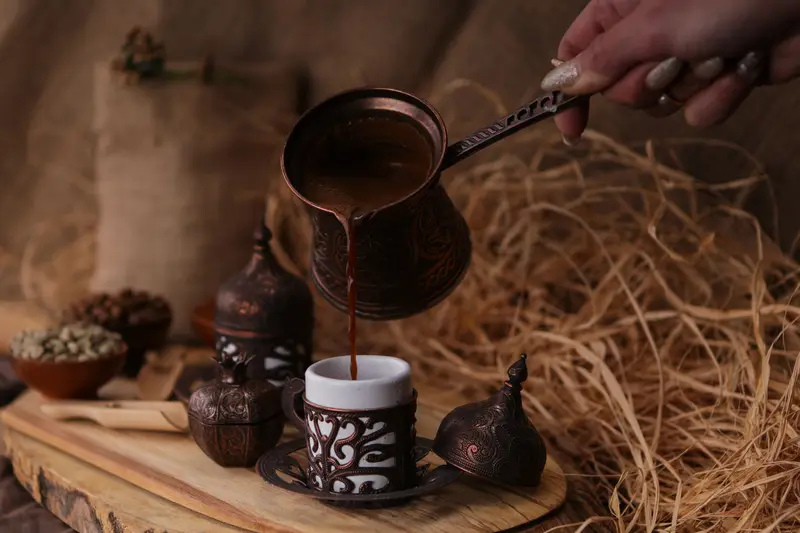
Definition. Turkish coffee: unfiltered coffee made by slowly heating very finely ground coffee with cold water (and optional sugar) in a small pot called a cezve, served in a small cup with its foam on top and its grounds at the bottom. The same method is known as Greek, Cypriot, Armenian, Bosnian or Arabic coffee in other communities.
Is Turkish coffee a type of bean or a way of brewing?
It is a way of brewing. No coffee plant or bean variety is called "Turkish coffee." The name describes what happens in the pot: powder-fine coffee and water are heated together and served without filtering. Beans from any growing region can be used, as long as they are ground fine enough.
This is the first thing to know when you shop. A bag labeled "Turkish coffee" tells you the grind and the intended method. It does not tell you the origin of the beans. You can brew a single-origin Ethiopian coffee this way, or a supermarket blend. Our guide to the best coffee for Turkish coffee covers roast and origin choices.
The pot has two common names in English. Cezve (JEZ-veh) is the Turkish word and the one we use on this site. Ibrik is the word many English speakers learned, and you will see both on packaging and menus. The cezve and ibrik guide explains the difference and how to choose one.
What makes Turkish coffee different from other coffee?
Four things set it apart: the grind is the finest of any method, the coffee is never filtered, a layer of foam is part of the drink, and the grounds are served in the cup. Each of these changes how the coffee tastes and how you drink it.
| Feature | Turkish coffee | Why it matters |
|---|---|---|
| Grind | Powder, finer than espresso | Extracts quickly and stays partly suspended in the cup |
| Filter | None | Fine particles and coffee oils end up in the drink, giving it body |
| Heat | Slow, in the pot with the water | Builds foam; the pot is pulled off before a rolling boil |
| Foam | Expected on every cup | A sign of care, called köpük (kuh-PEWK) |
| Grounds | Poured into the cup, left at the bottom | You stop drinking when you reach them |
| Sugar | Added in the pot before heating | You choose the level when you order |
| Serving | Small cup, 60 to 70 ml (about 2 to 2.4 fl oz), with water | Meant to be sipped slowly |
The grind. Turkish coffee needs coffee that feels like flour or cocoa powder between your fingers. Most home grinders cannot reach it. See Turkish coffee grind for what works.
No filter. Drip coffee passes through paper. Espresso passes through a metal basket. Turkish coffee passes through nothing. The liquid and the grounds go into the cup together, and gravity does the separating over a minute or two.
The foam. As the pot warms, a dense, dark foam gathers on the surface. Traditionally, a cup served without it is considered poorly made. Getting it right is mostly about patience and low heat. The foam guide explains the technique.
The grounds. The settled grounds are called telve (TEL-veh). They stay in the cup. You do not stir once it is poured, and you do not drink the last sip.
UNESCO's description of the tradition lists the same essentials: freshly roasted beans ground to a fine powder, cold water and sugar in the pot, slow heating until foam forms, and small cups served with a glass of water.
How is Turkish coffee made?
Cold water, coffee and any sugar go into the cezve together. The pot is heated slowly, without stirring after the first mix, until foam rises toward the rim. It comes off the heat before it boils over, and the coffee is poured gently into small cups so the foam carries across.
In outline:
- Measure one small cup of cold water per person into the cezve.
- Add 7 g of powder-fine coffee per cup (about one well-heaped teaspoon), and sugar if wanted.
- Stir briefly, then set over low heat.
- Watch as the foam builds and begins to rise. This takes about three minutes.
- Remove from the heat before it boils hard, and pour slowly.
- Wait a minute for the grounds to settle before the first sip.
That is the short version. Exact grams, milliliters, temperatures and timing are in our step-by-step guide: how to make Turkish coffee. If you do not own a cezve, see Turkish coffee without a cezve.
What does Turkish coffee taste like?
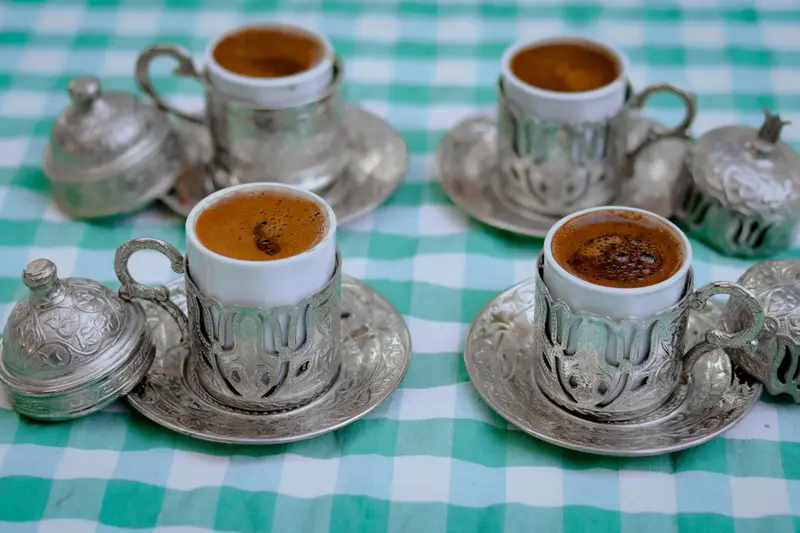
Turkish coffee tastes full and heavy, with a thick, almost velvety texture from the fine particles that stay suspended. It is strong in flavor but served in a small amount. Without sugar it is bittersweet and roasty. With sugar it tastes rounder, closer to dark chocolate.
Paper-filtered coffee is thin and clear. Turkish coffee is opaque and has weight on the tongue, and the bottom of the cup is sludge that you leave behind.
Strength is easy to misjudge. The flavor is concentrated, yet a cup holds only 60 to 70 ml (about 2 to 2.4 fl oz). In lab measurements, a small cup usually contains less caffeine than a 12 fl oz mug of drip coffee. The numbers and the sources are in how much caffeine is in Turkish coffee. For a side-by-side with the other famous small coffee, see Turkish coffee vs espresso.
Some regional versions add spice. Cardamom is common in many Arab preparations and appears in some Armenian ones. In Turkey the classic cup is unspiced, and gum mastic or other flavorings are regional variations.
How do you order Turkish coffee?
You order by sweetness, because the sugar is cooked into the coffee and cannot be adjusted later. The server will ask how you take it before the pot goes on the heat. No milk or cream is added. If you are unsure, medium is a common first choice.
| Turkish | Pronunciation | Meaning |
|---|---|---|
| sade | sah-DEH | Plain, no sugar |
| az şekerli | AHZ sheh-ker-LEE | A little sugar |
| orta | or-TAH | Medium sweet |
| şekerli | sheh-ker-LEE | Sweet |
Greek coffee shops commonly use their own words for the same idea (sketos for plain, metrios for medium, glykos for sweet), and Arab coffee shops may ask whether you want cardamom. In the United States, most places will understand "no sugar, medium or sweet."
A few more things to expect:
- It arrives with water. Take a sip of water first to clear your palate.
- Something sweet may come with it. A piece of lokum (Turkish delight) is traditional.
- Give it a minute. Let the grounds settle before you drink.
The full etiquette, including who is served first, is in how to serve Turkish coffee.
Do you drink the grounds?
No. Sip slowly and stop when the coffee turns thick and gritty, usually with about a quarter inch (half a centimeter) left in the cup. The grounds are not harmful, but they are unpleasant to drink, and leaving them is the normal thing to do.
What happens next is optional and popular. The drinker covers the cup with the saucer, turns it upside down and lets it cool. The patterns left by the grounds are then "read" as a fortune. This is a social game with a long history, and we cover it in Turkish coffee fortune telling.
Is Turkish coffee the same as Greek or Arabic coffee?
The method is shared, and the names differ. Greek, Cypriot, Armenian and Bosnian coffee are brewed in essentially the same way, in a pot each language names differently. "Arabic coffee" can mean the same cezve-style cup in the Levant, or a lighter, spiced, often unsweetened coffee poured from a dallah in the Gulf.
The method spread through the Ottoman world from the 16th century onward, and many nations made it their own. What you call it usually depends on who taught you to make it. On this site we describe every tradition by the name its own community uses. The details are in Turkish vs Greek vs Arabic coffee, and the background is in the history of Turkish coffee.
Where can you try Turkish coffee in the United States?
Look for Turkish, Greek, Armenian, Bosnian, Lebanese, Palestinian, Syrian, Egyptian and Yemeni coffee shops, bakeries and restaurants. Many brew to order in a cezve even when the menu only says "Turkish coffee" or "Greek coffee" in small print near the desserts.
Our Turkish Coffee Map of America lists places we have verified as serving cezve-style coffee, with the evidence and the date we checked. If you would rather start at home, the how-to guide needs about ten minutes and very little equipment. New words are explained in the glossary.
Sources
- UNESCO Intangible Cultural Heritage: Turkish coffee culture and tradition (element 00645)
- UNESCO: Decision of the Intergovernmental Committee 8.COM 8.28
- Republic of Türkiye Ministry of Culture and Tourism: Turkish coffee culture and tradition
- Hammad, Tayyem and Musaiger (2015), Caffeine content in beverages commonly consumed in Jordan, Pakistan Journal of Nutrition
- Gross, Jaccaud and Huggett (1997), Analysis of the content of the diterpenes cafestol and kahweol in coffee brews, Food and Chemical Toxicology 35(6):547-554
- Joanna Kakissis, Don't call it 'Turkish' coffee, unless, of course, it is, NPR The Salt (April 27, 2013)
- GoTürkiye (Türkiye Tourism Promotion and Development Agency): Turkish coffee
Questions people ask
Why is Turkish coffee served with a glass of water?
The water is for cleansing your palate before the first sip, so you taste the coffee clearly. Some people also drink it afterward to rinse away fine grounds. UNESCO's description of the tradition mentions the glass of water as part of the standard service.
Does Turkish coffee have milk in it?
Traditionally no. It is made with water only and drunk black, with or without sugar. A few modern coffee shops offer a version simmered in milk, usually listed separately on the menu, but the classic cup contains coffee, water and optional sugar.
Can I make Turkish coffee with regular ground coffee?
Not well. Drip and espresso grinds are too coarse. They sink quickly, give little foam and leave a gritty, weak cup. You need coffee ground to a powder, either bought pre-ground for this method or milled on a grinder that can go that fine.
Is Turkish coffee stronger than regular coffee?
It tastes stronger because it is more concentrated and unfiltered. A single small cup, though, generally carries less total caffeine than a large mug of drip coffee, since the serving is only about 2 fl oz. See our caffeine guide for measured figures.
Why is it called Turkish coffee?
European visitors met this style of coffee in the Ottoman Empire, where it was the everyday way to brew from the 16th century on, and the name stuck in Western languages. Other communities that share the method use their own names for it.