Guide
Cezve and ibrik guide: how to choose a Turkish coffee pot
A good cezve is small, heavy for its size, narrower at the neck than at the base, and matched to the number of cups you brew. Tin-lined copper responds fastest to heat, stainless steel is the easiest to own and works on induction, and the right size holds your water with a third of the pot to spare.
By Ahmet Kırtok · Updated November 26, 2026 · 9 min read
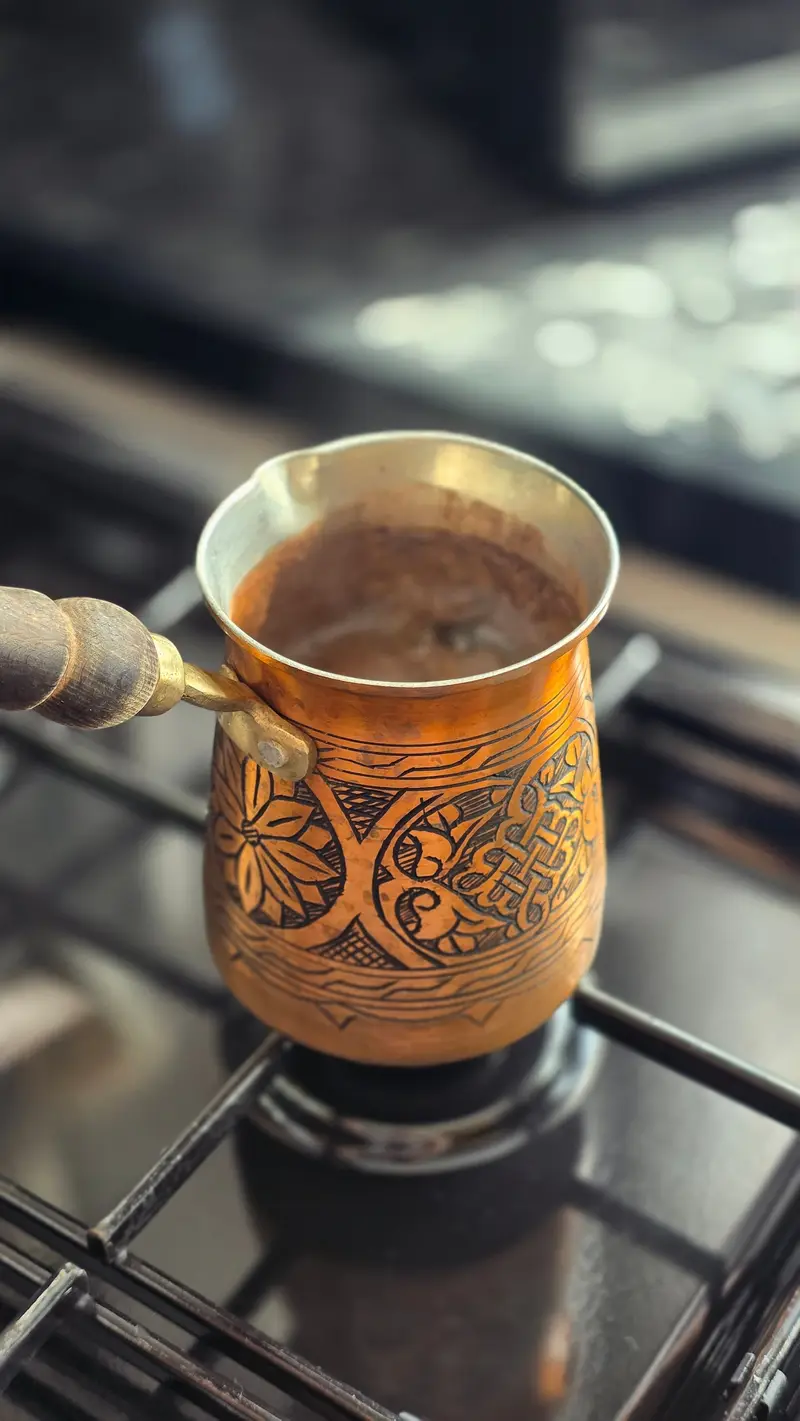
Cezve (JEZ-veh) is the Turkish name for the small, long-handled pot used across Turkey, Greece, the Balkans, Armenia and the Arab world. Many English speakers call it an ibrik. Greek speakers call it a briki, Bosnians a džezva, Armenians commonly a jazzve or srjep, and Arabic speakers a rakweh or kanaka, depending on the country. The pot is the same idea everywhere. This guide explains how to pick one without naming stores or brands.
Is it called a cezve or an ibrik?
Both words reach English from the same coffee tradition. In Turkish, the coffee pot is a cezve, and ibrik means a ewer or pitcher for water. English-language coffee writing adopted "ibrik" for the pot, and the world championship for this method uses both names: the Cezve/Ibrik Championship.
We use cezve on this site and mention ibrik because many readers search for it. Neither is wrong in English. For how the names and the drink differ by country, see Turkish vs Greek vs Arabic coffee and the glossary.
Which cezve material is best?
Tin-lined copper is the classic choice because copper moves heat quickly and evenly, so the pot answers the moment you lower the flame or lift it away. Stainless steel is slower and less even but nearly indestructible and dishwasher-safe. Brass sits between them. Ceramic is the slowest and most fragile.
The differences come down to thermal conductivity, the rate at which a material passes heat. Barista Hustle's cezve course lists copper at above 400 W/mK, brass at about 111 W/mK and stainless steel at 14 W/mK. The same lesson points out that copper cools quickly once it leaves the heat, while steel holds on to heat. In a brew where a few seconds separate a full foam from a boil-over, that responsiveness is what you are paying for.
| Material | Heat response | Lining | Induction | Care | Good for |
|---|---|---|---|---|---|
| Copper, tin-lined | Fastest and most even | Tin (sometimes silver) | No, unless it has a magnetic base | Hand wash, soft sponge, re-tin when worn | People who brew often and want the most control |
| Stainless steel | Slowest of the metals, can form a hot spot at the base | None needed | Only if a magnet sticks to the base | Easiest, usually dishwasher-safe | First cezve, induction kitchens, travel |
| Brass | Moderate | Tin or another food-safe lining | No | Hand wash, treat like copper | Decorative sets, Levantine-style pots |
| Ceramic or porcelain | Slow to heat, holds heat long | Glaze | No | Hand wash, avoid thermal shock | Gentle heat sources, serving at the table |
| Enameled steel | Moderate | Enamel | Often yes, check with a magnet | Hand wash, avoid chipping | Budget option |
A few plain observations follow from that table. Thicker metal is better than thinner in every material, because it spreads heat and resists dents. A hammered finish is decoration and does not change the coffee. And a cheap, thin stainless pot on high heat is the combination most likely to scorch grounds at the base, so with steel, keep the heat low and be patient.
Why are copper cezves lined with tin, and are they safe?
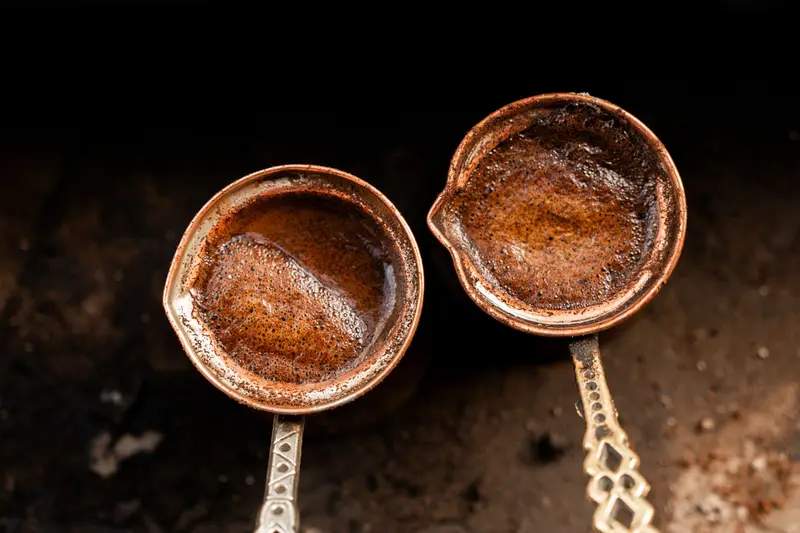
Copper cezves are lined so the coffee touches tin, a stable and relatively non-reactive metal, instead of bare copper. Brewed coffee is mildly acidic, and US food-service rules keep bare copper away from acidic foods. A lined pot in good condition is the standard, long-established way to use copper for coffee.
Here is the reasoning in numbers. Most brewed coffee has a pH of about 4.85 to 5.10, according to a peer-reviewed study summarized by Healthline. The FDA Food Code, in section 4-101.14, bars copper and copper alloys such as brass from contact with food below pH 6 in restaurants and other food businesses. States adopt that rule in their own codes, for example Washington and Minnesota. The rule governs food establishments, not home kitchens, but it is a sensible benchmark: choose a lined cezve, and do not brew in one whose lining has worn through.
When you shop, look inside. A tin lining is silvery-gray and slightly matte, often with visible wipe marks from being applied by hand. If the inside is the same color as the outside, the pot is unlined and is better kept as decoration. Sellers should state the lining material. If they cannot, pass.
This is general information and not medical advice. If you have a condition that affects how your body handles copper, ask your doctor before using copper cookware.
What size cezve do you need?
Buy for the number of cups you brew most often, not the largest number you might ever serve. Allow about 70 ml of water per cup and choose a pot whose total capacity is roughly one and a half times that, so the liquid sits at the base of the neck with room for foam to rise.
| Cups you brew | Water | Cezve capacity to the brim |
|---|---|---|
| 1 | 70 ml (2.4 fl oz) | about 100 to 120 ml |
| 2 | 140 ml (4.7 fl oz) | about 200 to 230 ml |
| 3 | 210 ml (7.1 fl oz) | about 300 to 340 ml |
| 4 | 280 ml (9.5 fl oz) | about 400 to 450 ml |
| 5 to 6 | 350 to 420 ml (11.8 to 14.2 fl oz) | about 500 to 600 ml |
These capacities are our working guide. Sellers label cezves by "cups" or by a size number, and neither is standardized, so check the listed volume in milliliters. Cup sizes vary too: a traditional fincan holds about 50 to 70 ml according to a 2023 survey of Turkish coffee styles in the Journal of Ethnic Foods, and modern sets can be larger.
Size matters more than most people expect. One cup brewed in a four-cup pot spreads into a shallow layer, heats too fast and makes a thin, short-lived foam. If you usually brew for one or two but host now and then, a two-cup pot plus a four-cup pot covers nearly everything.
Why does a cezve have a narrow neck?
The neck is narrower than the base so the rising foam is squeezed into a thick layer instead of spreading thin. The wide base takes in heat, the taper slows the rise and gives you a second or two to react, and the grounds tend to stay behind the shoulder when you pour.
Barista Hustle notes that the brew can temporarily double in volume as the foam forms. A straight-sided pan gives that expansion nowhere to gather. The taper is the reason a cezve makes better foam than a saucepan, which we cover in Turkish coffee without a cezve and in the foam guide.
When comparing pots, look for a base clearly wider than the neck, a flat bottom that sits steadily on your burner grate, and a pouring lip. Some pots have one lip on the left for right-handed pouring, some have two. If you are left-handed, check before buying.
What should the handle be like?
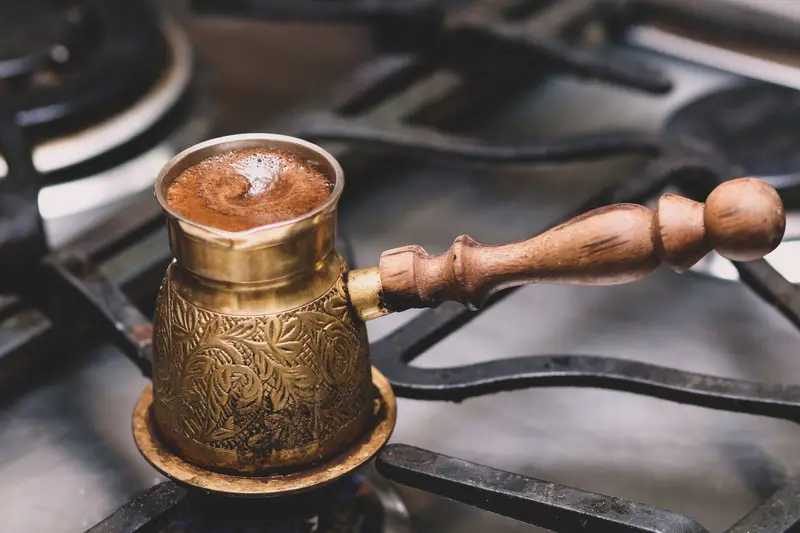
The handle should be long enough to keep your hand away from the flame, firmly attached, and angled upward. Wooden handles stay cool. Metal handles in brass or steel last longer and can go into hot sand, but they get hot on a gas burner, so keep a cloth nearby.
Check how the handle is fixed. Rivets or a solid weld are better than a single screw, and a screwed-in wooden handle should not wobble. A removable or folding handle is useful for travel. For brewing in sand, a longer handle is more comfortable because your hand hovers over a hot tray. See Turkish sand coffee.
Will a cezve work on an induction cooktop?
Only if its base is magnetic. Induction heats ferromagnetic metal such as cast iron and some stainless steels. Copper and aluminum usually do not work unless they are clad with a magnetic layer, as Consumer Reports explains. Hold a fridge magnet to the bottom: if it sticks, the pot should heat.
There is a second catch with small pots. Many induction hobs need a minimum base diameter before they detect a pan, and a one-cup cezve can fall below it. Check your cooktop manual for the figure. If your favorite pot is copper, an induction adapter plate, a flat steel disc that sits between hob and pot, will heat it, though more slowly and with less control than a flame.
On gas, use the smallest burner and a flame that stays under the base. If the grate is too wide for the pot, a stovetop reducer ring gives it a stable seat. Electric coil and glass-top stoves work with any flat-bottomed cezve.
How do you care for a cezve, and when does copper need re-tinning?
Rinse the cezve with warm water after each use, wipe it with a soft cloth or sponge, and dry it straight away. Never heat a tin-lined pot empty and never scrub the lining. Have copper re-tinned when patches of bare copper show through the lining on the inside.
Tin is soft and has a low melting point, 231.9 °C (449.4 °F), and it begins to soften well below that. Water-based brewing never gets near those temperatures, since the coffee itself stays at or under 100 °C (212 °F). An empty pot forgotten on a flame can pass them quickly, which is how linings get ruined.
- Daily: rinse, wipe out the grounds, dry. Kurukahveci Mehmet Efendi's care notes advise against soap or detergent on coffeepots, and thorough rinsing if you do use it.
- Never: steel wool, abrasive powders, metal spoons scraped against the lining, or the dishwasher for copper, brass and wooden-handled pots.
- Outside tarnish: copper darkens with use. That is cosmetic. Polish it with a paste of lemon juice and salt or a copper cleaner if you like it bright, and keep the polish off the lining.
- Lining color: tin dulls and darkens to gray over time. That is normal and does not mean it needs replacing.
- Re-tinning: when copper-colored spots appear inside, stop brewing in the pot and look for a re-tinning service, sometimes listed as copper cookware restoration. In Turkey the trade is called kalaycılık (kah-lie-juh-LUHK). It is a routine repair, and a re-tinned pot can serve for many more years.
Stainless steel needs none of this. Wash it however you like.
Where to go next
- Put the pot to work: how to make Turkish coffee
- Complete the set: how to serve Turkish coffee
- Background on the pot and the drink: history of Turkish coffee
- See the method done well before you buy anything: find a place on the Turkish Coffee Map of America.
Sources
- Barista Hustle: Brass, Copper, Silver, Aluminium, Glass, or Steel? (cezve materials and thermal conductivity)
- Barista Hustle: cezve/ibrik lesson on foam (raghweh)
- Washington Administrative Code 246-215-04115: Copper, use limitation (adopts FDA Food Code 4-101.14)
- Minnesota Rules 4626.0465: Copper, use limitation
- Healthline: Is coffee acidic? (pH 4.85 to 5.10, citing a peer-reviewed study)
- CenturyLife: Tin (properties of tin as a cookware lining)
- Consumer Reports: How to tell if a pot or pan is induction-compatible
- Kurukahveci Mehmet Efendi: useful information (cleaning coffeepots)
- Journal of Ethnic Foods (2023): Spatial distribution of Türkiye's local Turkish coffee kinds
Questions people ask
Is an unlined copper cezve safe to use?
We recommend against brewing in one. Coffee is mildly acidic, and US food-service rules keep bare copper and brass away from foods below pH 6. Those rules cover restaurants, not homes, but a tin-lined or stainless steel pot avoids the question entirely.
How long does a tin lining last?
There is no fixed lifespan. It depends on how often you brew, how gently you clean and whether the pot has ever been overheated. With water-based brewing, soft cleaning and no dry heating, a lining can last for years. Replace it when bare copper shows through.
Can I put a cezve in the dishwasher?
Plain stainless steel cezves usually can, if the maker says so. Copper, brass, tin-lined and wooden-handled pots should be washed by hand. Dishwasher detergent dulls copper, is hard on tin, and dries out or loosens wooden handles.
What is the best cezve for a beginner?
A two-cup stainless steel or tin-lined copper cezve of about 200 to 230 ml. It is forgiving for one cup, correct for two, and small enough to make good foam. Choose stainless steel if you cook on induction or want no maintenance.
Does a more expensive cezve make better coffee?
Price mostly buys thicker metal, better handle fittings and hand decoration. Thickness and correct size affect the coffee. Engraving does not. A plain, heavy, properly lined pot in the right size will brew as well as an ornate one.
Can I use a cezve for anything else?
Yes. It is a handy small pot for melting butter, warming milk or heating a single portion of syrup. If you also brew coffee in it, rinse it well afterward, since fats and strong flavors can linger and carry into the next cup.