Guide
How to make Turkish coffee without a cezve
You can make Turkish coffee without a cezve in a butter warmer, a small milk pot or your smallest saucepan. The recipe stays the same: 7 g of flour-fine coffee per 70 ml of cold water, low heat, off before it boils. Expect thinner foam and a trickier pour, both of which have workarounds.
By Ahmet Kırtok · Updated November 26, 2026 · 9 min read
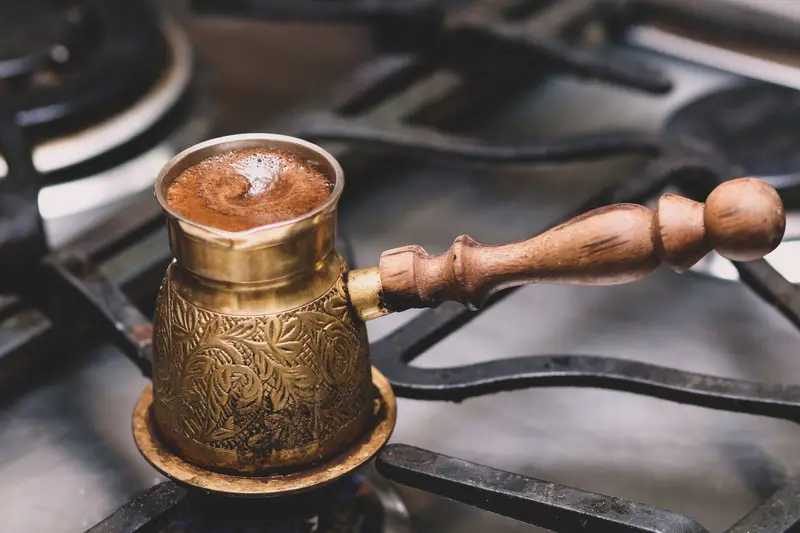
The cezve (JEZ-veh), which many English speakers call an ibrik, is a simple tool, and its job can be approximated. What cannot be substituted is the grind. If you only fix one thing before your first cup, get coffee ground to a true Turkish powder. The pot can wait. This guide is honest about what each stand-in does well and where it falls short.
Can you really make Turkish coffee without a cezve?
Yes. Turkish coffee is defined by its method: very finely ground coffee heated with water, and usually sugar, then served unfiltered so the grounds settle in the cup. Any small pot that heats gently can do that. A cezve makes the foam and the pour easier, which is why it remains the standard tool.
Peter Giuliano of the Coffee Science Foundation, quoted by Popular Science, describes the method as decoction, meaning the grounds are heated together with the water, in contrast to drip and espresso, where water passes through a bed of coffee. Nothing in that definition requires a particular pot. Kurukahveci Mehmet Efendi's own description of Turkish coffee does name the cezve as the vessel, and the improvised version is close without being identical.
What can you use instead of a cezve?
The best substitutes are small, narrow and equipped with a pouring lip. In order of preference: a butter warmer, a small milk pot, a stainless steel milk-frothing pitcher on gas or electric coil, and last, the smallest saucepan you own. The smaller the surface of the liquid, the better the foam.
| Stand-in | Typical size | Foam | Pour | Verdict |
|---|---|---|---|---|
| Butter warmer | Often 250 to 500 ml (1 to 2 cups US) | Fair to good | Good, most have a spout | The closest match in a US kitchen. Brew two cups at a time. |
| Small milk pot or Turkish-style milk warmer | About 500 ml to 1 liter | Fair | Good | Fine for two to four cups. Too wide for one. |
| Steel milk-frothing pitcher | 350 to 600 ml (12 to 20 fl oz) | Fair to good | Excellent | Tapered shape helps. Only use one that the maker rates for direct heat, with a handle that will not melt. |
| Small saucepan | 1 quart (about 950 ml) and up | Thin | Awkward without a lip | Works when nothing else is available. Brew three or four cups and tilt the pan. |
The sizes are general ranges for US cookware, so check your own. Material matters as well as shape. Barista Hustle's cezve course gives copper a thermal conductivity above 400 W/mK and stainless steel 14 W/mK, and notes that steel stays hot after it leaves the flame. Most substitutes are stainless steel, so the coffee keeps heating for a moment after you lift the pan. Take it off a touch earlier than you would a copper cezve.
On induction, the pan must be magnetic and large enough for the hob to detect. Consumer Reports' magnet test settles the first question. Your cooktop manual answers the second.
How do you make Turkish coffee in a small saucepan?
Use the standard recipe and make at least two cups so the liquid has some depth: 14 g of coffee and 140 ml of cold water. Stir once, heat on the lowest setting, tilt the pan as the foam forms, lift it off before it boils, spoon the foam into the cups and pour slowly.
- Measure for two cups or more. Pour 140 ml of cold water into the pan, measured with your serving cup (two cupfuls). Add 14 g of Turkish-ground coffee, about two well-heaped teaspoons, and sugar if you take it.
- Stir once. Stir for 10 to 15 seconds until there are no dry clumps. Do not stir again.
- Heat on low. Use your smallest burner at its lowest steady setting. Stay with the pan.
- Tilt as it warms. When a dark ring appears at the edge, tilt the pan gently toward one side so the liquid pools deeper. Foam gathers better in the deeper pool.
- Lift at the rise. When the foam thickens and starts to swell, take the pan off the heat. In a wide pan the rise is subtle, so watch for the ring closing over the surface.
- Spoon the foam first. Share the foam between the cups with a teaspoon.
- Pour or ladle. Pour slowly from the lip. If the pan has no lip, use a small ladle or a spoon for the first half of each cup, then pour the rest.
- Rest. Wait one to two minutes for the grounds to settle before drinking.
This follows the same order as the traditional method in Kurukahveci Mehmet Efendi's cezve instructions, adapted for a wider pan. We skip the second rise here. In a wide pan a second heating is more likely to boil the coffee than to add foam.
For timing, sugar levels and a table for one to four cups, see the full recipe in how to make Turkish coffee.
What changes when you do not use a cezve?
Four things change: the foam is thinner, the brew heats faster, more water evaporates, and pouring is harder. The taste stays close if you control the heat. The difference people notice first is the look of the cup, since the foam cap is the hardest part to reproduce.
| What changes | Why | What to do about it |
|---|---|---|
| Thinner foam | A wide surface spreads the foam into a thin layer. A cezve's narrow neck gathers it. | Brew two or more cups, tilt the pan, spoon the foam into cups first. |
| Faster heating | A shallow layer over a wide base takes in heat quickly. | Lowest burner setting. Lift the pan on and off the heat if it is racing. |
| More evaporation | More surface area is exposed for the same volume. | Add about a teaspoon (5 ml) of extra water per cup if your cups come up short. |
| Harder pour | No lip, and grounds slide out with the last of the liquid. | Ladle or spoon the first half, pour slowly, and leave the last tablespoon in the pan. |
| Easier to boil over or scorch | Thin steel has hot spots, and the rise is harder to see. | Never walk away. Stir thoroughly at the start so no coffee sits dry on the base. |
Barista Hustle notes that the brew can roughly double in volume for a moment as the foam forms. A tapered pot forces that expansion upward into a thick band. Our foam guide goes deeper.
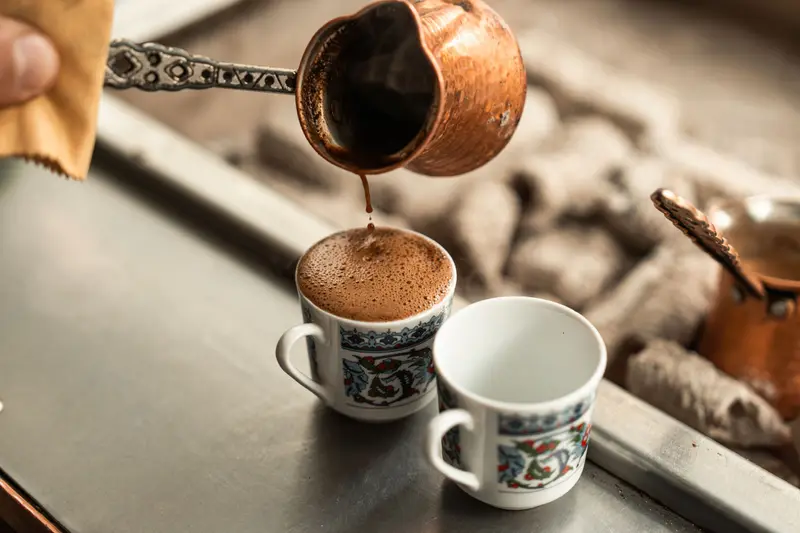
Are electric Turkish coffee machines any good?
Electric Turkish coffee machines are a well-established category in Turkey: countertop appliances that heat a small pot or chamber and stop automatically when the coffee rises. They suit people who want a consistent cup with no watching. They take away the hands-on control, and most are designed around Turkish-style cup sizes.
The category has a clear starting point. Arçelik, the Turkish appliance maker, says it introduced its Telve machine in June 2004 and describes it as the world's first Turkish coffee machine. That claim is the company's own. The same page lists the kinds of features that have since become common across brands: a sensor that detects when the coffee is cooked, protection against boiling over, an audible alert, automatic water intake on some models, and versions that brew several cups at once.
Traditional roasters accept the method too. Kurukahveci Mehmet Efendi publishes a separate brewing guide for electric machines alongside its cezve instructions.
In broad terms there are three kinds:
- Electric cezve. A small pot with a heating element in the base, like a tiny kettle. It is cheap and simple, has no automatic stop on the basic versions, and needs watching just like a stovetop pot.
- Semi-automatic machine. You add water, coffee and sugar to a removable pot, press a button, and the machine stops at the rise. This is the most common home type.
- Automatic machine with a water tank. The machine doses the water itself and may brew several pots at once. Larger versions are made for offices and coffee shops.
Things to check before buying one in the US:
- Voltage and plug. Appliances made for Turkey and Europe run on 220 to 240 V. US outlets supply 120 V. Buy a model built for the US market and confirm it on the rating label.
- Cup size. Capacity is stated in Turkish coffee cups of roughly 60 to 70 ml, so a "four-cup" machine makes far less than four American mugs.
- Cleaning. Fine grounds cling to sensors and pot walls. Machines need rinsing after every use, following the manual.
We have not tested machines and do not rank them. A cezve costs less and teaches you more. A machine is a reasonable tool when you want coffee for guests while you do something else.
What does not work as a substitute?
Other coffee makers do not make Turkish coffee, because they all filter the grounds out. A moka pot, French press, drip machine or espresso machine will give you its own kind of coffee from the same beans. Microwaving and pouring boiling water over the grounds also miss the slow rise that builds the foam.
- Moka pot. It pushes water up through a filter basket, and powder this fine can clog the filter, which is a hazard in a pressurized pot. Do not use Turkish grind in one.
- French press. It steeps, then filters through a mesh that Turkish powder passes straight through or clogs. The result is muddy without the foam.
- Espresso machine. It is a different drink made under pressure. See Turkish coffee vs espresso.
- Kettle and cup. Pouring boiling water over Turkish grounds in a cup gives a strong, unfiltered coffee with no foam. It is a traveler's shortcut.
- Microwave. Heating is uneven and sudden boil-overs are likely. We do not recommend it.
When is it worth buying a cezve?
If you make Turkish coffee more than a few times, buy one. A plain two-cup cezve is a small, inexpensive pot that lasts for years, and it fixes the two things substitutes do worst: foam and pouring. Stainless steel is the easiest to own, and tin-lined copper gives the most control.
Our cezve and ibrik guide covers materials, sizes in milliliters and care. While you decide, order a cup from a place that makes it properly so you know what you are aiming for. The Turkish Coffee Map of America lists US coffee shops and restaurants that serve cezve-style coffee.
Where to go next
- The complete recipe: how to make Turkish coffee
- The part you cannot improvise: Turkish coffee grind
- Choosing beans: best coffee for Turkish coffee
- Presenting it: how to serve Turkish coffee
Sources
- Kurukahveci Mehmet Efendi: brew guide, Turkish coffee with cezve
- Kurukahveci Mehmet Efendi: brew guide index (lists a separate guide for electric Turkish coffee machines)
- Kurukahveci Mehmet Efendi: Turkish coffee, definition and history
- Arçelik: Dünyanın İlk Türk Kahvesi Makinesi Telve 20 Yaşında (company blog, in Turkish)
- Popular Science: How to enjoy the flavor, history, and science of Turkish coffee (with Peter Giuliano, Coffee Science Foundation)
- Barista Hustle: cezve/ibrik lesson on foam (raghweh)
- Barista Hustle: Brass, Copper, Silver, Aluminium, Glass, or Steel? (thermal conductivity)
- Consumer Reports: How to tell if a pot or pan is induction-compatible
Questions people ask
What is the best substitute for a cezve?
A butter warmer. It is small, has a pouring spout, and many US kitchens already have one. Brew two cups at a time so the liquid is deep enough for the foam to gather, and keep the heat as low as your stove allows.
Can I make Turkish coffee in a regular pot?
Yes, in the smallest one you have. Make three or four cups so the coffee is not a thin film on the base, tilt the pot as the foam forms, and ladle the first half of each cup. The foam will be thinner than from a cezve.
Can I use a moka pot or French press for Turkish coffee?
No. Both filter the coffee, and Turkish coffee is served unfiltered. Turkish-fine powder can also block a moka pot's filter, which can be unsafe in a pressurized brewer. Use those brewers with their own grind for their own style of coffee.
Do I need special coffee if I do not have a cezve?
You need the same coffee: ground to Turkish fineness, like flour. That matters more than the pot. Regular drip or espresso grounds will not extract properly or settle cleanly. Buy coffee labeled for Turkish coffee or ask a roaster to grind for it.
Is an electric Turkish coffee maker better than a cezve?
It is more convenient and more consistent, and it will not boil over while you look away. A cezve gives you control over heat, timing and foam, and costs much less. Which is better depends on whether you value the hands-on process.
Why is my saucepan Turkish coffee watery?
The usual culprits are a coarse grind or too much water, not the pan. Weigh 7 g of true Turkish-ground coffee for every 70 ml of water, measure the water with your serving cup, and check the grind with the pinch test: it should feel like flour.