Blog post
Adding Turkish coffee to your menu: a guide for coffee shops and restaurants
A coffee shop or restaurant can add Turkish coffee with modest equipment: cezves and a heat source, a sand heater, or an automatic machine, plus coffee ground to a powder and small cups. The harder parts are training staff to manage foam, fitting a made-to-order drink into service, and setting a price from real costs.
By Ahmet Kırtok · Updated November 26, 2026 · 6 min read
This post is for owners and managers of US coffee shops and restaurants. It contains no financial projections, because we have no sourced figures to offer.
Why add Turkish coffee to your menu?
The strongest reasons are specific to your business: guests already ask for it, your kitchen has roots in a culture that drinks it, or you want a distinctive drink for the hours after dinner. We have no reliable national data on demand for Turkish coffee in the United States, so we give none.
What equipment do you need?
You need a way to heat a small pot slowly, the pots themselves, powder-fine coffee and the right cups. There are three practical routes for the heat. They differ in cost, counter space, skill required and how much of a show they make.
| Route | What it is | Strengths | Trade-offs |
|---|---|---|---|
| Cezve on a burner | Hand brewing in a cezve (JEZ-veh), also called an ibrik | Lowest equipment cost; full control | Needs attention for every cup; skill varies |
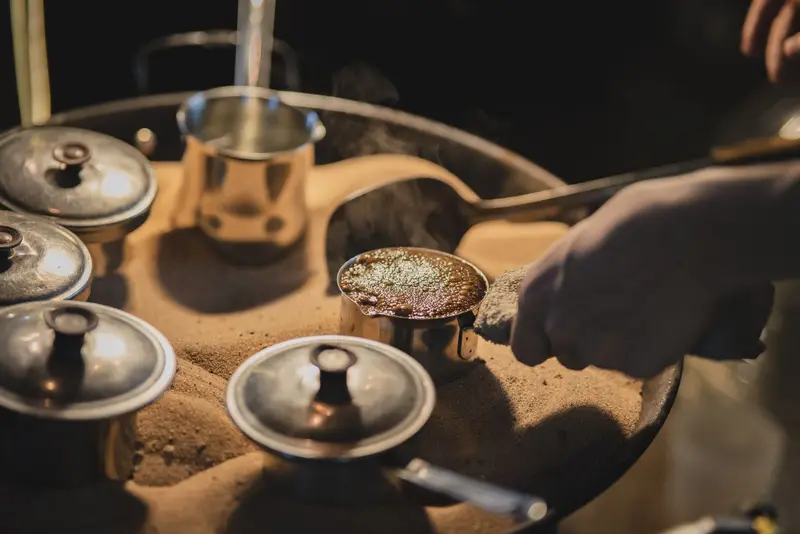
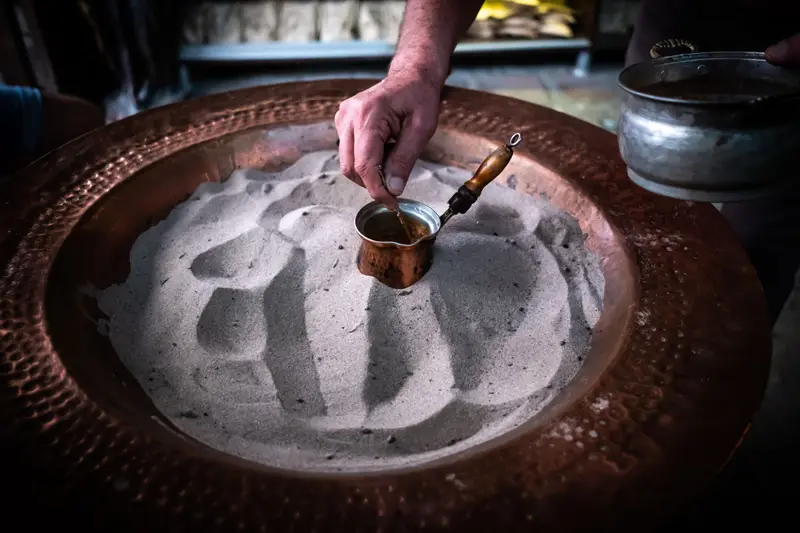
| Hot sand | Cezves pushed into a bed of heated sand | Gentle heat; strong visual appeal | Counter space; warm-up time |
| Automatic machine | Heats the pot and stops when it senses the foam | Consistent; little training | Less control; machine cost and upkeep |
On the third route, Arçelik describes its Telve Pro as a professional machine that brews nine cups at once with induction heating and can draw water from a mains connection. Home machines sold in the US are smaller: Beko lists a six-cup model that brews in about two minutes on 120 volts. See electric Turkish coffee machines for how the sensors work, the cezve guide for pots, and the sand coffee guide for that method.
The rest of the list is short:
- Cezves in two or three sizes, so each order is brewed in a pot that fits.
- Coffee ground for this method. It must be a powder, finer than espresso. Buy it pre-ground and manage freshness, or confirm that your grinder can reach it. See the grind guide.
- Small cups with saucers, and small glasses for water.
- A tray or board for service.
What should you ask your health department first?
Ask before you buy. Rules for equipment in food establishments are enforced locally, and inspectors can have views on household appliances, open sand and unlined copper.
Questions worth asking:
- Does equipment used behind the counter need a commercial sanitation certification, and does the model I am considering have one?
- Are there requirements for a hot sand unit on the counter, such as a guard or a distance from customers?
- Are there rules on the materials of pots that touch food, including lined and unlined copper?
- Does adding this drink change anything in my current permit?
Requirements differ between jurisdictions, and we are not a regulatory authority.
How long does it take to train staff?
The steps can be shown in a few minutes. Doing them reliably during a rush takes repetition. The skill is in the last twenty seconds: recognizing when the foam is rising and pouring before it breaks. Plan practice time before the drink goes on the menu.
What staff need to learn:
- The house recipe. Fixed amounts of coffee and water for each cezve size, written down. Our brewing guide gives a starting point.
- Sugar goes in before brewing. The order must include the sugar level, or the cup has to be remade.
- Foam. How to get it and how to divide it between two cups. See the foam guide.
- Service. Cup and water in the same arrangement every time. See how to serve Turkish coffee.
- How to explain it. It is unfiltered, the grounds settle, and you stop before the bottom.
How do you fit it into service?
Decide where it is made, who makes it and what happens when three orders arrive together. Hand-brewed Turkish coffee takes a few minutes of one person's attention per pot, and it cannot be batched ahead and held.
- Give it a station with pots, coffee, sugar, cups and heat within reach.
- Say "brewed to order" on the menu, so guests know why it takes longer.
- Brew for two. A two-cup cezve serves a pair at one sugar level in one pass.
How should you price it?
Build the price from your own cost per cup and then check it against what your market will bear. The standard method in coffee shops and restaurants is cost percentage: divide the total cost of one drink by its selling price. Work backward from the percentage you target across your menu.
We give no dollar figures here, since costs differ by city and supplier. These are the parts to add up:
| Cost component | What to count |
|---|---|
| Coffee | Grams per cup at your supplier's price |
| Sugar and water | Minor, but include them |
| Accompaniment | The sweet on the saucer and the glass of water, if you serve them |
| Labor | Minutes of attention per pot; easy to leave out |
| Serviceware | Cups, saucers and trays, including breakage |
| Equipment | Purchase cost spread over its expected life, plus fuel or electricity |
| Waste | Remakes while staff are learning, and stale coffee thrown out |
Labor per cup is high compared with drip coffee, so the ingredient cost alone will make the drink look more profitable than it is. Then look at what comparable places near you charge. If your price sits well above or below theirs, know why.
What do customers expect?
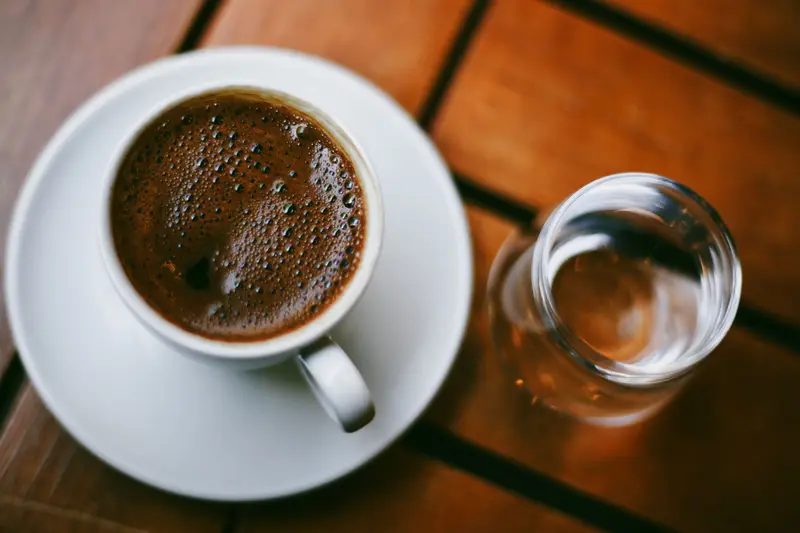
Guests who know the drink expect to be asked about sugar, to see foam on the cup, to get a glass of water and to be given time. Guests who do not know it need a sentence of guidance so the grounds at the bottom do not come as a surprise.
- The sugar question. Asked at the order, every time. Our post on how to order Turkish coffee lists the levels and the Turkish terms.
- Foam. A cup without it reads as a mistake to anyone who grew up with this coffee.
- Water. UNESCO's description of the tradition includes the glass of water served with the cup.
- A name that fits your house. Turkish, Greek, Armenian, Bosnian and Arabic coffee share a method and differ in name and detail. Use the name that is true to your kitchen.
How do you get listed once you serve it?
Add the drink to your online menu in words, then send us the link. A basic listing on TurkishCoffee.us is free, and it requires one public page showing that you serve this coffee. We check it, write the listing in our own words, and publish it with the date.
Use the add a place form to add your place, or claim your listing if it is already on the map. The page for businesses explains what a listing includes and what the paid options add, and how we check listings sets out the evidence standard. Paying never changes the order of listings.
Sources
- Arçelik Global: Telve Pro professional Turkish coffee maker (9 cups, induction, water-line option)
- Beko US: TKM 8961 UC Turkish coffee machine (6 cups, about 2 minutes, 120 V)
- Toast: How to make a coffee shop menu pricing strategy (cost percentage formula)
- UNESCO: Turkish coffee culture and tradition (preparation and service)