Guide
Turkish sand coffee: how brewing in hot sand works
Turkish sand coffee, kumda kahve, is ordinary Turkish coffee brewed in a cezve pushed into a tray of hot sand instead of set over a flame. The sand heats the pot from the sides as well as the base, and depth controls the heat. Its effect on taste is tradition and reasoning more than tested fact.
By Ahmet Kırtok · Updated November 26, 2026 · 9 min read
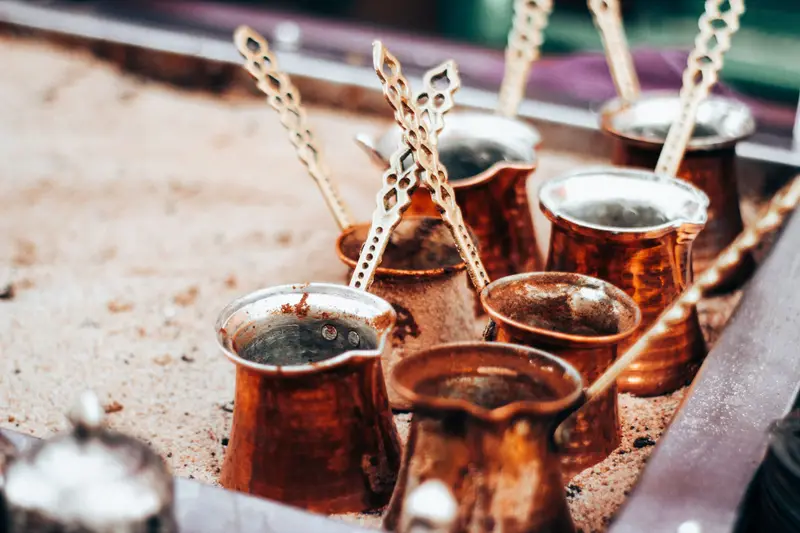
Kumda kahve (koom-DAH kah-VEH) means "coffee in sand." You may have seen it in a video: a row of small copper pots sliding through a tray of sand, the coffee swelling up within seconds of being pushed deeper. It is a real, long-practiced technique and also a piece of theater, and both are worth understanding. The pot is the same cezve (JEZ-veh), or ibrik, used on a stove.
What is Turkish sand coffee?
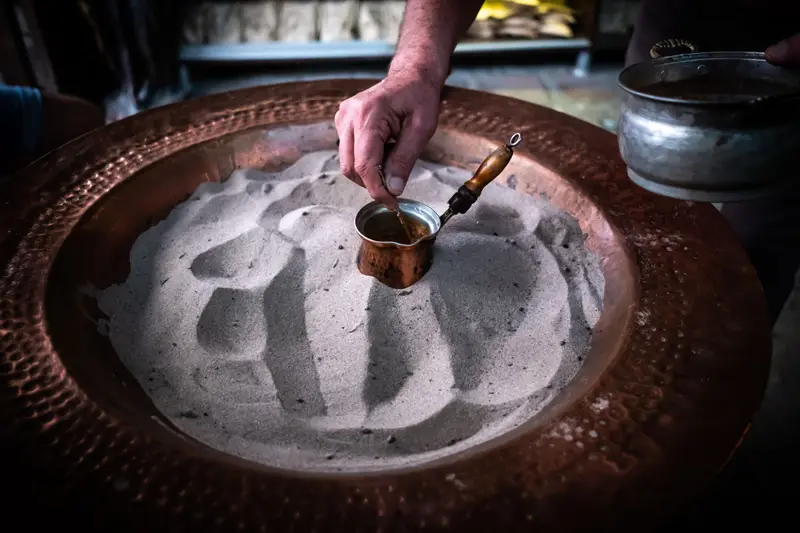
Sand coffee is a way of heating, not a different drink. The coffee, grind, water and sugar are the same as in any Turkish coffee. The difference is the heat source: a metal tray of fine sand kept hot from below, with the cezve nestled into it until the foam rises.
Türkiye's tourism portal makes the same distinction. Its overview of Turkish coffee types groups coffee cooked on sand, on coals and in ashes as methods of cooking, separate from styles defined by a bean or an added flavor, and calls sand probably the most traditional of them. A 2023 survey of regional styles in the Journal of Ethnic Foods describes fine sand heated on a metal sheet, with coffee cooked in a copper cezve for about seven minutes, or directly in the cup for about ten.
That second detail, brewing in the cup, is a variant you may come across: the coffee and water go straight into a heatproof cup that is set in the sand. Coffee heated on embers, közde kahve (kuz-DEH kah-VEH), is a close relative. The same study says ember-brewed coffee was typically reserved for very important guests in the Ottoman period.
The method is not exclusive to Turkey. Sand trays are also used by Greek, Cypriot, Arab and Balkan coffee makers. We could not find a reliable, dated account of where or when it began, so we will not offer one. For the wider story, see the history of Turkish coffee.
How does brewing coffee in hot sand work?
Hot sand surrounds the lower part of the cezve, so heat enters through the walls as well as the base. The maker controls the temperature by depth: pushing the pot deeper speeds it up, lifting it or moving it to cooler sand at the edge slows it down. The coffee is ready when the foam rises.
Three physical features explain why the method has lasted:
- Contact area. On a flame, heat arrives mostly through the base. In sand, the pot is heated wherever the sand touches it. The coffee warms more evenly from bottom to top.
- A heat reservoir. A deep bed of sand stores a lot of heat and changes temperature slowly. Once it is hot, it stays steady, which would have suited kitchens and coffeehouses that kept embers or a stove going all day.
- Depth as a dial. Before adjustable burners, moving a pot a few centimeters deeper or shallower was a precise way to manage heat. Writers who have watched it describe it in these terms, including Colin Nagy's 2025 account.
Published figures for the sand's temperature are scarce. Tasting Table gives about 380 °F (roughly 193 °C) without naming a source, so treat that as an indication. Whatever the sand's temperature, the coffee itself behaves as it does on a stove: the foam builds as the liquid nears boiling point. Barista Hustle's cezve course puts the start of foam near 88 °C (190 °F) and advises pouring before 93 °C (199 °F).
Sand does not automatically mean slow. With very hot sand and a pot buried deep, the coffee can rise within a minute or two.
Does sand coffee taste different?
Possibly, but nobody has shown it under controlled conditions. We found no published blind tasting or laboratory comparison of sand-brewed and stove-brewed Turkish coffee. What is well supported is that heating speed and final temperature affect the cup. Sand is one way to control those, and a careful hand on a low flame is another.
Here is how the common claims hold up.
| Claim | What supports it | Our reading |
|---|---|---|
| Sand heats the pot more evenly than a flame | Basic heat transfer: sand touches the sides as well as the base | Sound reasoning. The effect is larger for steel pots than for copper, which conducts heat far better (above 400 W/mK against 14 W/mK) and evens itself out on any heat source. |
| Sand gives finer control | Depth changes the heat instantly, and the bed holds a steady temperature | True for a practiced maker with a hot, deep bed. A modern adjustable burner also gives fine control. |
| Sand makes thicker, more stable foam | Stated by makers and by appliance companies, for example SAKI's description of its sand-style brewer | Plausible when sand slows the rise, since slow heating favors foam. It is a manufacturer's claim, with no independent test that we could find. |
| Sand coffee is less bitter | Repeated in food media, usually without a source | Unproven. Bitterness depends on roast, grind, time and whether the pot boiled, on any heat source. |
| It tastes better | Individual accounts | Personal. Setting, expectation and the skill of the person making it all shape the experience. |
Türkiye's tourism portal does say the cooking method affects taste, and many experienced coffee makers agree. We take that seriously as practitioners' knowledge. We also think the honest summary is this: sand is a good tool for slow, even heating, the people who use it daily tend to be skilled, and those two facts explain most of what ends up in the cup.
Can you make sand coffee at home?
Yes, with a heavy pan, clean dry sand and patience. Fill a cast-iron skillet or deep steel pan with 4 to 5 cm (about 2 inches) of fine sand, heat it on a burner for 15 to 20 minutes, nestle the cezve in and brew as usual. It is slower than the stove and mostly done for enjoyment.
These quantities and times are untested starting points and will vary with your stove and pan.
What you need
- A cast-iron skillet, Dutch oven or deep steel pan that you are willing to dedicate to sand
- Clean, dry, fine sand with no additives, dyes or coatings. Rinse it and dry it fully before first use, since damp sand can spit and steam.
- A metal cezve, ideally with a long handle. See the cezve guide.
- A heat source you can leave on steadily: gas or an electric coil is simplest
Steps
- Fill the pan. Add sand to a depth of 4 to 5 cm, enough to bury the lower third of the cezve.
- Heat the sand. Set the pan over medium heat for 15 to 20 minutes, stirring the sand once or twice with a metal spoon so it heats through.
- Prepare the coffee. In the cezve, stir 7 g of Turkish-ground coffee and any sugar into 70 ml of cold water per cup. The full recipe is in how to make Turkish coffee.
- Nestle the pot. Push the cezve into the sand so the sand comes about a third of the way up its sides. Mound a little more sand around it.
- Manage the heat by depth. If nothing happens after several minutes, push the pot deeper or toward the center. If it races, lift it slightly or slide it to the edge.
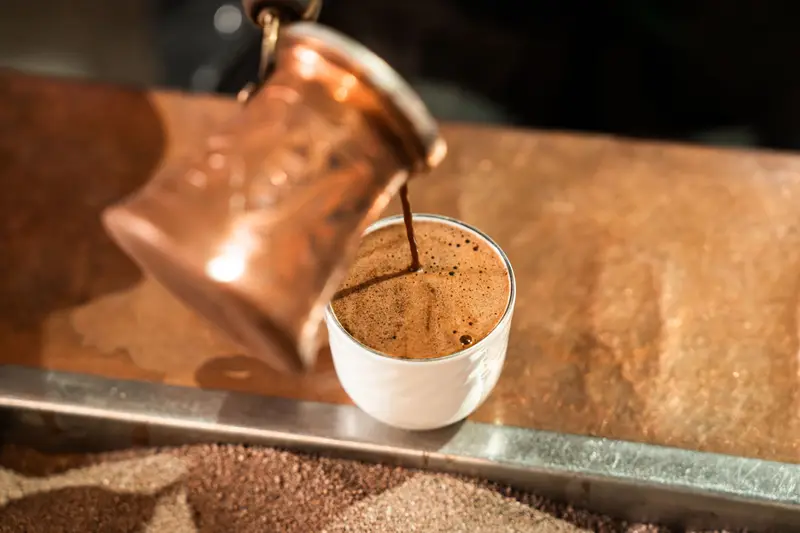
- Lift at the rise. When the foam ring closes and the surface climbs, lift the cezve out. Spoon foam into the cups, return the pot briefly for a second rise if you like, and pour.
- Let everything cool. Turn off the heat and leave the pan where it is until the sand is completely cold.
Safety
- Hot sand looks exactly like cold sand and holds its heat for a long time. Keep children and pets away, and do not move the pan while it is hot.
- Use only dry sand, and never add water to hot sand.
- Sand will scratch a glass or ceramic cooktop. Use a gas burner or coil, or protect the surface and lift the pan instead of sliding it.
- Do not leave a tin-lined copper cezve sitting empty in hot sand. Tin melts at 231.9 °C (449.4 °F) and softens below that. With liquid inside, the lining stays near the coffee's temperature.
- Wipe sand off the base of the pot before pouring, so no grains fall into the cup.
What should you look for in a coffee shop that offers sand coffee?
Look for a place that brews each order fresh in the sand, asks how sweet you want it before starting, and serves it with foam, a glass of water and a minute to settle. A sand tray on the counter is a good sign of interest in the craft, though it does not guarantee a good cup.
A few things to watch and ask:
- Is the sand doing the brewing? In a working setup the pots sit in the sand from cold until the foam rises. A tray used only to keep pre-brewed coffee warm is decoration.
- Do they ask about sugar first? Sugar is cooked in. A coffee shop that asks sade, orta or şekerli before brewing knows the method. See the sugar levels.
- Does it boil hard? A brief rise, even repeated two or three times, is normal showmanship. A long rolling boil flattens the foam and makes the cup harsh.
- Is there foam in your cup? Careful makers share the foam between cups before pouring. Our foam guide explains why it matters.
- Is the cup the right size? A small cup of about 60 to 70 ml, served with water, is the standard. See how to serve Turkish coffee.
Sand trays turn up in some Turkish, Greek, Arab, Armenian and Balkan coffee shops in the United States. Our directory, the Turkish Coffee Map of America, lists verified places that serve cezve-style coffee and notes the brewing method where we have been able to confirm it. Where we have not confirmed it, the listing says so, and it is worth calling ahead if sand is the reason for your visit.
Where to go next
- The underlying recipe: how to make Turkish coffee
- The right grind for any heat source: Turkish coffee grind
- How neighboring traditions brew: Turkish vs Greek vs Arabic coffee
- The basics: what is Turkish coffee?
Sources
- Journal of Ethnic Foods (2023): Spatial distribution of Türkiye's local Turkish coffee kinds
- GoTürkiye: Just for the coffee gourmets out there, types of Turkish coffees
- Tasting Table: Why is Turkish coffee heated with hot sand? (June 9, 2025)
- Why is this interesting? (Colin Nagy): The Sand Coffee Edition (October 30, 2025)
- SAKI: What is the SandBrew method and how does it work? (manufacturer support page)
- Barista Hustle: cezve/ibrik lesson on foam (raghweh)
- Barista Hustle: Brass, Copper, Silver, Aluminium, Glass, or Steel? (thermal conductivity)
- CenturyLife: Tin (melting point and softening of tin linings)
- UNESCO Intangible Cultural Heritage: Turkish coffee culture and tradition
Questions people ask
Why is Turkish coffee made in sand?
Sand is a steady, even heat source that warms the pot from the sides as well as the base, and the maker can adjust the heat by moving the pot deeper or shallower. It gave precise control long before adjustable burners, and it remains popular partly because it is beautiful to watch.
Is sand coffee stronger than regular Turkish coffee?
No. Strength depends on how much coffee and water go into the pot, and sand coffee uses the same recipe. The heat source changes how the pot is warmed. A sand-brewed cup and a stove-brewed cup made with the same quantities contain the same amount of coffee.
Does the sand touch the coffee?
No. The sand stays outside the pot and only heats the metal. The coffee is brewed inside the cezve exactly as on a stove. A careful maker wipes or taps the base of the pot before pouring so stray grains do not fall into the cup.
What kind of sand is used for sand coffee?
Fine, clean, dry sand. Fine grains pack closely around the pot and pass heat well. For home use, choose plain washed sand with no additives, dyes or coatings, rinse it, and dry it completely before heating it for the first time.
How long does sand coffee take?
It varies with how hot the sand is. A regional survey in the Journal of Ethnic Foods describes about seven minutes in a copper cezve. Coffee shops with very hot, deep sand can raise a pot in a minute or two. At home, allow five to eight minutes.
Can I use an electric or induction stove to heat the sand?
An electric coil works well. On induction, the pan holding the sand must be magnetic, such as cast iron, and you should take care not to scratch the glass. A gas burner is the simplest choice. In every case, let the sand cool fully before moving the pan.